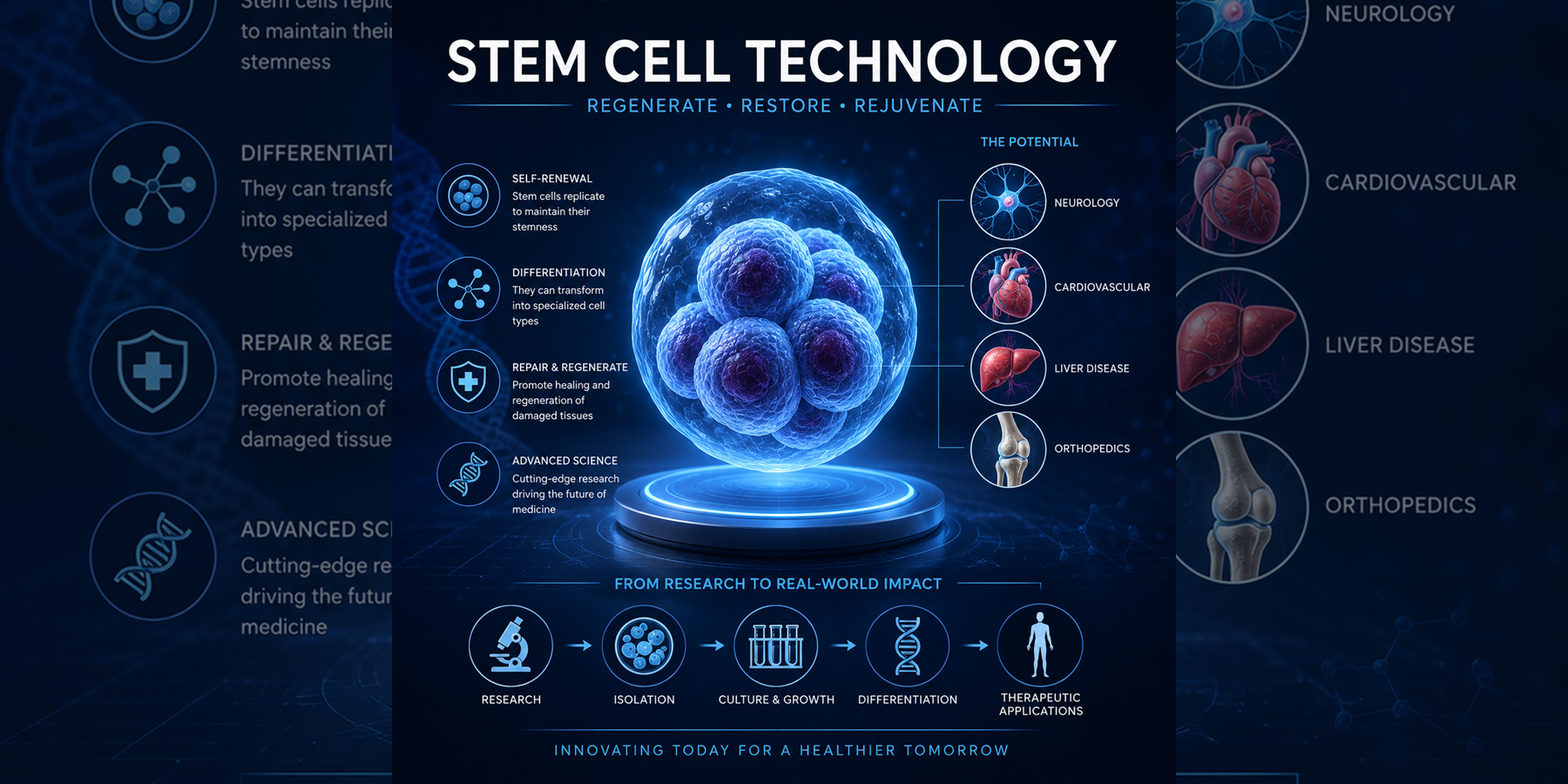
Self-Renewal
The remarkable ability of stem cells to divide and produce identical copies of themselves, maintaining the stem cell pool throughout an organism's lifetime.
Stem Cell Technology
Self-Renewal | Differentiation | Potency | Plasticity | Lineage
Pioneering stem cell research and clinical applications to repair damaged tissues, combat degenerative diseases, and unlock the future of regenerative health.
Core Principles
Understanding the core biology that drives stem cell science and its potential to transform medicine.
The remarkable ability of stem cells to divide and produce identical copies of themselves, maintaining the stem cell pool throughout an organism's lifetime.
The process by which undifferentiated stem cells transform into specialized cell types, from neurons to cardiomyocytes, guided by molecular signals.
The developmental range of a stem cell, from totipotent cells that can form all cell types to pluripotent and multipotent cell states.
The future developmental identity of a stem cell, determined by intrinsic genetic programs and external environmental signals from the niche.
The ability of stem cells to adapt and generate different cell types, including through transdifferentiation across traditional lineage boundaries.
The capacity of a single stem cell to proliferate and form a complete colony, confirming true stemness and self-renewal potential.
The potency spectrum moves from cells that can form all tissues to terminally differentiated specialized cells.
Classification
A comprehensive classification of stem cell populations by potency, source, and specialized function.
Can give rise to all embryonic and extraembryonic tissues, including placenta.
Can generate nearly all cell types in the body, including embryonic stem cells and iPSCs.
Can form related cell types within a tissue family, such as blood, bone, cartilage, or fat.
Can differentiate into a limited set of related lineages.
Can produce one mature cell type while maintaining self-renewal capacity.
Pluripotent stem cells derived from the inner cell mass of a blastocyst.
Tissue-resident stem cells that maintain and repair specific organs throughout life.
Adult cells reprogrammed back to a pluripotent state using Yamanaka factors.
A rich source of hematopoietic stem cells used in transplantation and banking.
Fetal-associated stem-like cells with research potential across multiple lineages.
Bone marrow and cord blood cells that generate all blood and immune cell types.
Multipotent stromal cells that can generate bone, cartilage, fat, and supportive signaling effects.
Cells capable of producing neurons, astrocytes, and oligodendrocytes for nervous system repair research.
Laboratory & Clinical
Key biological and technical processes that underpin stem cell science from bench to bedside.
Growing stem cells in controlled laboratory conditions with specific media, temperature, and oxygen levels to maintain viability and pluripotency.
Requires serum-free media, feeder cells or feeder-free matrices, and strict GMP conditions for clinical applications.
Increasing stem cell numbers in culture through passaging to generate sufficient quantities for research or therapy.
Clinical applications require bioreactors and careful monitoring to prevent differentiation or senescence.
Converting differentiated somatic cells into induced pluripotent stem cells using Yamanaka factors: Oct4, Sox2, Klf4, and c-Myc.
This revolutionized regenerative medicine by enabling patient-specific stem cells without embryo destruction.
The reversal of mature, specialized cells into a less differentiated state, increasing their plasticity and regenerative potential.
Direct conversion from one mature cell type to another without passing through a pluripotent intermediate state.
Storage of stem cells at ultra-low temperatures, commonly minus 196 degrees Celsius in liquid nitrogen, to preserve viability and genetic integrity.
The successful integration and establishment of transplanted stem cells into host tissues, measured by survival, migration, and functional contribution.
Regulated cell death that eliminates damaged, excess, or unwanted cells and helps prevent tumor formation.
Communication between stem cells and their environment using growth factors, cytokines, morphogens, and pathways such as Wnt, Notch, Hedgehog, and TGF-beta.
Therapeutic Applications
Translating stem cell science into clinical therapies that repair, replace, and regenerate damaged tissues.
Treatment involving transplantation of living stem cells to restore or replace damaged tissues, including autologous and allogeneic approaches.
HSC transplantation for leukemia, CAR-T cell therapy, and MSC infusions for graft-versus-host disease.
Combining living cells, biocompatible scaffolds, and engineering principles to create functional replacement tissues.
Cartilage repair scaffolds, bioengineered skin grafts, and vascular constructs.
3D printing of biological tissues using bioinks composed of living cells, growth factors, and biomaterials to construct complex tissue architecture.
Organoid printing, corneal tissue fabrication, and heart patch printing.
Miniature lab-grown tissue structures that self-organize from stem cells to resemble real organs.
Intestinal organoids, brain organoids, liver organoids, drug screening, and disease modeling.
MSCs and other stem cells regulate immune responses through paracrine signaling, offering therapeutic potential for autoimmune diseases and transplant rejection.
Crohn's disease, multiple sclerosis, and transplant tolerance research.
Combining CRISPR-Cas9 genome editing with stem cell technology to correct genetic mutations before transplantation.
Sickle cell disease correction, beta-thalassemia, and SCID gene therapy.
Patient's own cells minimize rejection risk and are ideal for iPSC-based therapies.
Donor cells require HLA matching and are commonly used in HSC transplantation.
Cross-species transplantation remains largely experimental and presents immune challenges.
Molecular & Genetic
The molecular tools and advanced concepts driving the next generation of stem cell science.
Guide RNA directs Cas9 nuclease to a target DNA sequence for precise cleavage and editing, supporting corrected stem cell therapies.
Reveals cell clustering, marker gene expression, differentiation trajectories, and cell-cell interactions at individual-cell resolution.
Gene regulation without DNA sequence changes. Yamanaka factors control stem cell identity and reprogramming.
Stem cells communicate through exosomes and paracrine signaling to regulate immune responses and promote tissue repair.
Advanced Concepts
The specialized microenvironment that protects and regulates stem cell behavior through physical contact and molecular signals.
Formation of new blood vessels, critical for engraftment and tissue vascularization.
Presence of genetically distinct cell populations in one organism after stem cell transplantation.
Cellular aging leading to irreversible loss of proliferative capacity, a barrier to expansion and therapy.
Engineering biological systems to create novel therapeutic cells with programmable functions.
Enzyme that maintains chromosome ends in stem cells, preserving genomic integrity across divisions.
Ethical & Regulatory
Responsible stem cell technology balances scientific progress, patient safety, privacy, consent, and transparent clinical evidence.
Ethical frameworks govern stem cell research while balancing scientific progress with respect for human life and dignity.
Donors and patients must understand risks, benefits, and alternatives before providing biological material or entering trials.
Cryogenic storage of cord blood, iPSCs, and other stem cells for future use, regulated for quality and privacy.
Investigational New Drug applications must be filed before human clinical trials to ensure safety, purity, and potency.
Stem cell treatments lacking sufficient clinical evidence pose serious patient safety risks.
Somatic Cell Nuclear Transfer creates embryos for stem cell derivation, a controversial but valuable research approach.
Reference Guide
A comprehensive reference of stem cell terminology, from foundational concepts to advanced clinical nomenclature.
FAQ
Evidence-based answers to common questions on this topic.
Stem cells are undifferentiated cells capable of self-renewal and differentiation. They are important because they support tissue development, repair, disease modeling, drug discovery, and regenerative therapy research.
Stem cells can be classified by potency, such as totipotent, pluripotent, multipotent, oligopotent, and unipotent, or by source, such as embryonic, adult, induced pluripotent, cord blood, and amniotic fluid stem cells.
Established and emerging applications include blood cancers, inherited blood disorders, graft-versus-host disease, cartilage damage, wound healing, immune disorders, and experimental therapies for neurological, cardiac, and degenerative conditions.
Autologous transplants use the patient's own cells, reducing rejection risk. Allogeneic transplants use donor cells and require compatibility testing to manage immune rejection.
iPSCs are created by reprogramming adult somatic cells with transcription factors such as Oct4, Sox2, Klf4, and c-Myc, returning the cells to a pluripotent state.