Genetic Makeup
DNA variants, polymorphisms, copy number changes, gene duplications, and structural rearrangements can influence disease susceptibility and drug response.
Precision Medicine
Genomics | Pharmacogenomics | Multi-Omics | AI | Personalized Therapeutics
Tailoring disease prevention, diagnosis, and treatment to the unique genetic, environmental, and molecular characteristics of each individual - the right treatment, for the right patient, at the right time.
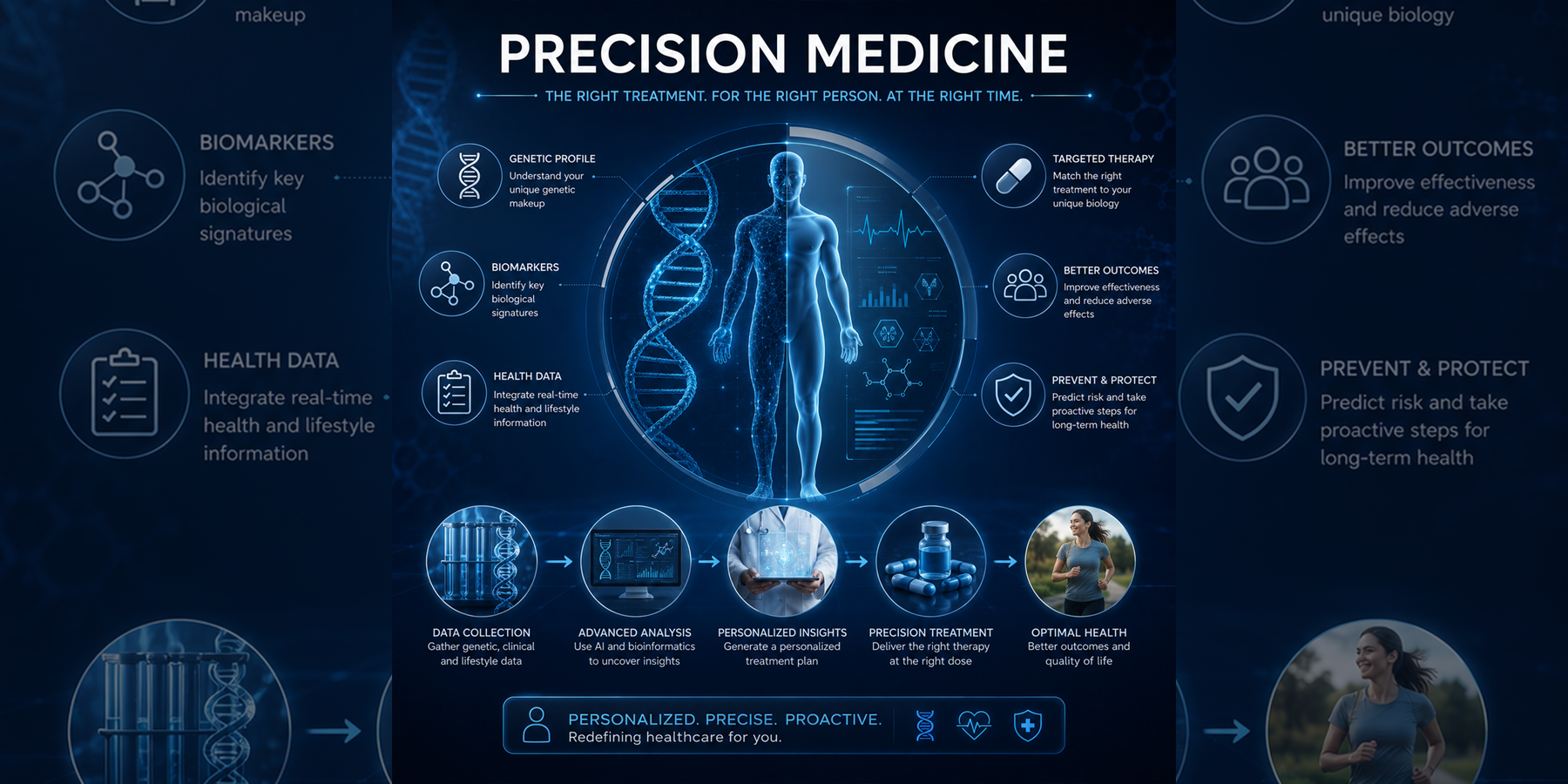
Overview
Precision medicine tailors disease prevention, diagnosis, and treatment according to an individual's genetic makeup, environment, lifestyle, and molecular profile.
DNA variants, polymorphisms, copy number changes, gene duplications, and structural rearrangements can influence disease susceptibility and drug response.
External exposures, clinical setting, nutrition, and health history shape prevention strategies and treatment planning.
Behavior, activity, diet, sleep, and long-term health patterns help clinicians personalize risk reduction and therapeutic choices.
Transcriptomics, proteomics, metabolomics, and biomarkers reveal active biological processes beyond DNA sequence alone.
Genetic differences in drug metabolism genes such as CYP2D6 and CYP2C19 help optimize drug selection, dosing, efficacy, and toxicity risk.
Precision medicine is transforming oncology, cardiology, psychiatry, neurology, infectious diseases, and rare genetic disorders.
Part I
An innovative healthcare approach that considers individual differences in genes, environment, lifestyle, and biological characteristics when making medical decisions.
"An approach that accounts for individual variability in genes, environment, and lifestyle to improve prevention and treatment strategies."- National Institutes of Health
Match therapies to each patient's molecular profile for optimal outcomes.
Pharmacogenomic profiling helps prevent harmful drug interactions and side effects.
Identify susceptibility early before clinical symptoms emerge.
Detect disease risks through genomic and biomarker screening programs.
Build individualized care plans based on genetic, environmental, and lifestyle data.
Replace broad-spectrum treatments with precision-targeted interventions.
Part II
Key scientific milestones transformed medicine from a reactive discipline toward predictive, preventive, and personalized care.
Mapped approximately 3 billion base pairs of the human genome, providing unprecedented insight into human genetics and disease mechanisms.
NGS dramatically reduced the cost and time required for genome analysis, making whole-genome and whole-exome sequencing practical clinical tools.
The U.S. Precision Medicine Initiative later expanded into the NIH All of Us Research Program targeting over one million diverse participants.
Large-scale health, genomic, and environmental data collection aims to improve individualized healthcare and medical research diversity.
Part III
The scientific foundation: studying an individual's complete genetic makeup to identify variations linked to disease susceptibility, prognosis, and treatment response.
Analyzes the entire genetic code - 3 billion base pairs - of an individual.
Can RevealFocuses on protein-coding regions of genes, containing the majority of disease-related variants.
Can RevealGuides PARP inhibitor therapy and surgical risk reduction
Selects patients for EGFR tyrosine kinase inhibitors (erlotinib, osimertinib)
Indicates eligibility for trastuzumab (Herceptin) and related targeted therapies
Determines eligibility for anti-EGFR therapy (cetuximab, panitumumab)
Guides BRAF inhibitor therapy (vemurafenib, dabrafenib)
Identifies candidacy for ALK inhibitor therapy (crizotinib, alectinib)
Part IV
Genetic differences influence drug metabolism, efficacy, and toxicity, making pharmacogenomics one of the most successful applications of precision medicine.
Choose the most effective agent for each patient's genetic profile.
Personalize dosing to metabolizer status - poor, intermediate, normal, or rapid.
Identify high-risk patients before prescribing potentially harmful drugs.
Forecast therapeutic response before initiating costly treatments.
CYP2C9 and VKORC1 variants influence metabolism and dosing requirements, helping reduce bleeding risk.
CYP2C19 loss-of-function variants can reduce activation, diminishing platelet inhibition and increasing cardiovascular risk.
Companion diagnostics match tumor molecular profiles to targeted agents for personalized cancer care.
CYP2D6 genotyping helps avoid toxicity in ultra-rapid metabolizers and lack of benefit in poor metabolizers.
Choose the most effective agent for each patient's genetic profile.
Personalize dosing to metabolizer status: poor, intermediate, normal, or rapid.
Part V
Translating genomic and molecular discoveries into clinical realities across major disease domains.
Cancer is the most advanced application of precision medicine. Tumors possess unique molecular signatures guiding therapy selection through molecular profiling to identify mutations that drive tumor growth.
Key ApplicationsTargeted tyrosine kinase inhibitors (osimertinib) achieve superior outcomes vs. chemotherapy.
Trastuzumab and pertuzumab precisely target HER2-amplified tumors.
Genetically engineered T-cells destroy cancer cells in blood malignancies.
Comprehensive panel testing guides multi-agent targeted therapy combinations.
Genome sequencing has significantly improved diagnosis and treatment for rare diseases - identifying pathogenic variants responsible for previously undiagnosed conditions, enabling earlier intervention.
Key ApplicationsWGS-based programs resolving diagnostic odysseys for patients with no known diagnosis.
Family-level genomic risk assessment for heritable conditions.
Expanded panel screening identifies treatable conditions before symptom onset.
Precision biologics targeting specific enzyme deficiencies in lysosomal storage disorders.
Genomic testing identifies inherited cardiovascular disorders, enabling early preventive measures and personalized treatment strategies before life-threatening events occur.
Key ApplicationsSarcomere gene mutations guide family screening and activity restriction.
LDLR/PCSK9 mutations identify patients requiring aggressive LDL reduction.
Ion channel gene variants guide drug avoidance and ICD decisions.
Precision cholesterol therapy targeting patients with specific genetic variants.
Precision medicine approaches are increasingly applied to neurology - improving diagnosis, stratifying disease subtypes, and identifying novel therapeutic targets for complex brain disorders.
Key ApplicationsAPOE4 genotyping stratifies risk; amyloid biomarkers guide therapy eligibility.
LRRK2 and GBA mutations identify subtypes with specific therapeutic implications.
Ion channel gene variants guide anti-seizure medication selection.
Chromosomal microarray and WES improve diagnostic yield in autism and intellectual disability.
Pharmacogenomic testing is increasingly integrated into clinical practice - guiding drug selection and dosing across psychiatry, cardiology, oncology, and infectious disease.
Key ApplicationsCYP450 genotyping guides antidepressant and antipsychotic selection.
HLA-B*5701 testing prevents abacavir hypersensitivity reactions.
TPMT/NUDT15 genotyping prevents myelosuppression in inflammatory bowel disease.
Genomic screening before drug exposure prevents adverse events proactively.
Precision medicine is transforming drug development - using molecular biomarkers to enrich clinical trials, identify responder populations, and accelerate approval pathways.
Key ApplicationsTumor-agnostic trials targeting shared genomic alterations across cancer types.
Co-developed biomarker tests required for targeted therapy prescribing.
Real-time biomarker data adjusts trial arms for improved efficiency.
Genomic stratification improves trial success rates and reduces development costs.
Part VI
Integrating biological data layers with AI-driven analysis gives clinicians and researchers a richer view of disease and patient variability.
Genomics, transcriptomics, proteomics, metabolomics, and epigenomics combine DNA variants, gene expression, proteins, metabolites, and epigenetic changes.
Integrated genomic and multi-omic data can improve diagnosis and treatment prediction beyond genomics alone.
Process millions of variants across diverse patient populations.
Detect subtle molecular signatures invisible to traditional methods.
Machine learning models forecast individual drug efficacy from multi-omic data.
AI can identify molecular markers for disease diagnosis and stratification.
Decision-support systems integrate genomic data into care workflows.
Deep learning platforms identify therapeutic targets from complex biological data.
Part VII
Precision medicine raises privacy, equity, discrimination, and informed-consent questions that must be addressed for responsible implementation.
Genomic data is highly sensitive, immutable, and relevant to family members and future generations.
Research has overrepresented European-ancestry populations, limiting accuracy for diverse communities.
Concerns remain about misuse by employers, insurers, and other institutions.
Patients must understand incidental findings, hereditary risk, and data-sharing policies.
Ongoing dialogue among researchers, clinicians, policymakers, patients, and ethicists is essential.
The Genetic Information Nondiscrimination Act provides partial protection, but gaps remain.
Part VIII
Healthcare infrastructure, data management, cost, and access remain major barriers, while emerging technologies are reshaping the next decade.
AI will increasingly support diagnosis, treatment prediction, and drug development.
CRISPR-based technologies may directly correct disease-causing mutations.
Cancer treatment will increasingly combine genomic, proteomic, and metabolomic profiles.
Population-level genomic and environmental data can target interventions at scale.
Wearables, biosensors, and EHR data further individualize patient monitoring.
Unified platforms will combine genomics, transcriptomics, proteomics, metabolomics, and microbiome data.
Reference Guide
Comprehensive definitions spanning Regenerative Medicine, Stem Cell Biology, Genomics, Precision Medicine, Pharmacogenomics, and AI.
An undifferentiated cell capable of self-renewal and differentiation into specialized cell types.
The ability of a stem cell to divide and produce identical stem cells indefinitely.
The process by which stem cells become specialized, functional cell types.
The developmental potential of a stem cell, ranging from totipotent to unipotent.
The ability of a stem cell to give rise to nearly all cell types in the body.
Adult cells reprogrammed back to a pluripotent state using Yamanaka factors.
Pluripotent stem cells derived from the inner cell mass of a blastocyst.
A partially specialized descendant of a stem cell with limited differentiation capacity.
Stem cells residing in bone marrow that give rise to all blood cell types.
A field focused on repairing, replacing, or regenerating damaged tissues and organs.
The creation of biological substitutes using cells, scaffolds, and signaling molecules.
A structural framework that supports cell attachment, growth, and tissue formation.
Natural or synthetic materials engineered to interact with biological systems for therapeutic purposes.
Water-swollen polymeric material used as a scaffold to encapsulate cells and support tissue growth.
3D printing using bioinks containing living cells to fabricate tissue and organ structures.
Miniature, self-organized 3D tissue structures grown in vitro that recapitulate organ architecture.
Transplant using the patient's own cells or tissues, minimizing immune rejection risk.
Transplant using cells or tissues from a matched donor.
Transplantation of cells or organs from a different species into a human recipient.
Formation of new blood vessels, essential for engraftment and tissue vascularization.
Signaling proteins that stimulate cell growth, proliferation, and differentiation.
The study of an organism's complete set of DNA, including all genes and their interactions.
Complete analysis of all 3 billion base pairs of an individual's DNA.
Sequencing of protein-coding regions that contain many disease-relevant variants.
High-throughput DNA sequencing technologies enabling rapid, cost-effective genome analysis.
A single base-pair variation in the genome between individuals.
Variations where segments of the genome are duplicated or deleted.
A heritable genetic change present in all cells of the body.
A genetic change occurring in non-reproductive cells, not heritable but often important in cancer.
A genomic variant whose clinical impact is not yet established.
An estimate of genetic predisposition to a trait or disease based on many variants.
Genome-wide association study scanning thousands of genomes to identify variants linked to disease.
A healthcare approach tailoring prevention and treatment to individual genetic, environmental, and lifestyle factors.
A measurable biological indicator used to assess disease state, prognosis, or therapeutic response.
A diagnostic test co-developed with a targeted therapy to identify patients likely to benefit.
A treatment that interferes with specific molecular targets involved in disease, especially cancer.
Non-invasive sampling of circulating tumor DNA or cells in blood for cancer diagnosis and monitoring.
Comprehensive analysis of a tumor or patient's molecular characteristics to guide therapy.
Tumor suppressor genes whose mutations significantly increase breast and ovarian cancer risk.
Epidermal growth factor receptor, a key oncogenic driver in lung cancer targeted by TKIs.
A receptor tyrosine kinase overexpressed in some breast cancers and targeted by trastuzumab.
The study of how an individual's genetic profile influences drug metabolism, efficacy, and toxicity.
A family of liver enzymes responsible for metabolizing many common drugs.
A person with reduced or absent enzyme activity, increasing risk of drug accumulation and toxicity.
A person who metabolizes drugs too quickly, reducing therapeutic effect.
Enzyme that metabolizes warfarin; variants affect required dosing.
Enzyme critical for clopidogrel activation; loss-of-function variants reduce antiplatelet effect.
Highly polymorphic enzyme metabolizing opioids, antidepressants, and antipsychotics.
Gene encoding the target of warfarin; variants influence anticoagulation sensitivity.
A harmful or unintended response to a drug at normal therapeutic doses.
A predictable alteration in drug effect caused by a patient's genetic variant.
Integration of multiple omic data layers for holistic disease analysis.
Study of all RNA transcripts expressed in a cell or tissue at a given time.
Large-scale study of all proteins expressed by a cell, tissue, or organism.
Comprehensive analysis of small-molecule metabolites reflecting cellular biochemical activity.
Genome-wide study of epigenetic modifications including DNA methylation and histone changes.
Analysis of gene expression at the level of individual cells, revealing cellular heterogeneity.
AI systems that learn patterns from data to make predictions or decisions without explicit programming.
Neural network-based AI capable of detecting complex biological patterns in large datasets.
A precise genome editing tool using guide RNA to direct Cas9 nuclease to cut specific DNA sequences.
Computational methods for storing, analyzing, and interpreting biological data.
Treatment strategy that introduces, alters, or replaces genetic material within a cell to treat disease.
Cells are removed, genetically modified in the lab, then reinfused into the patient.
Genetic material is delivered directly into the patient's body using a vector.
A modified virus used to deliver therapeutic genetic material into target cells.
A commonly used viral vector for gene therapy due to its safety and tissue-targeting ability.
T cells genetically engineered to express chimeric antigen receptors targeting cancer cells.
Scientific References
Ali, U., et al. (2026). Integration of pharmacogenomics into precision medicine. Frontiers in Pharmacology.
Evans, W., et al. (2024). Precision Medicine - Are We There Yet? A Narrative Review. Journal of Personalized Medicine, 14(4), 383.
FDA. (2018). Precision Medicine. U.S. Food and Drug Administration.
FDA. (2026). Table of Pharmacogenomic Biomarkers in Drug Labeling. U.S. Food and Drug Administration.
Hasanzad, M., et al. (2021). Genomic Medicine on the Frontier of Precision Medicine. Current Genomics, 22(5), 353-364.
Khan, A., et al. (2025). Genomic Medicine and Personalized Treatment. Journal of Translational Medicine.
Mani, S., et al. (2025). Genomics and Multiomics in the Age of Precision Medicine. Pediatric Research, 98, 1-13.
Mendez, K. M., et al. (2025). A Roadmap to Precision Medicine Through Post-Genomic Integration. Nature Communications, 16, Article 56442.
National Institutes of Health (NIH). (2025). The Promise of Precision Medicine.
NIH All of Us Research Program. (2025). Precision Medicine Research Initiative.
Nygren, P., et al. (2025). Precision Cancer Medicine 2025: Some Concerns. Cancer Medicine.
Roberts, M. C., Holt, K. E., & Allen, C. G. (2024). Precision Public Health in the Era of Genomics and Big Data. Nature Medicine.
Weinshilboum, R., & Wang, L. (2017). Pharmacogenomics: Precision Medicine and Drug Response. Mayo Clinic Proceedings, 92(11), 1711-1722.
Educational content covering genomics, pharmacogenomics, multi-omics, ethics, clinical applications, glossary, and references.