Neural Signaling
Nociceptors, spinal pathways, brain regions, inflammation, and sensitization shape how pain is produced, amplified, and perceived.
Science, Care, Relief
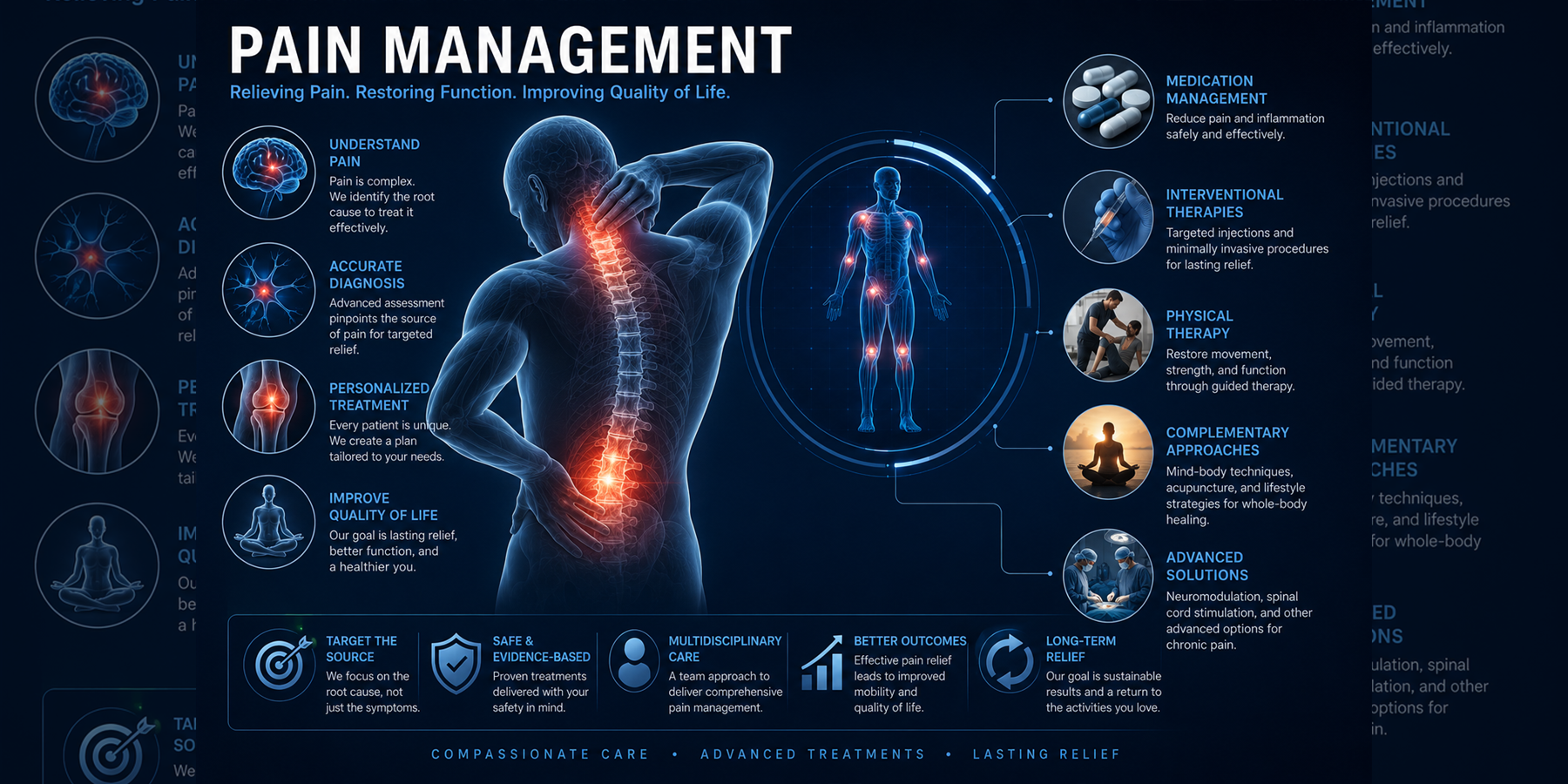
Scientific principles and clinical approaches for treating acute and chronic pain - integrating neuroscience, pharmacology, psychology, rehabilitation medicine, interventional procedures, and precision pain medicine.
Abstract
Pain is a complex sensory and emotional experience associated with actual or potential tissue damage. It protects the body, but persistent pain can become disabling when the nervous system stays sensitized.
Nociceptors, spinal pathways, brain regions, inflammation, and sensitization shape how pain is produced, amplified, and perceived.
Effective care measures success through improved sleep, mobility, work capacity, social participation, and meaningful activity, not pain scores alone.
Best practice combines medication, rehabilitation, behavioral care, procedures, complementary therapies, and precision tools based on the pain mechanism.
Part I
Modern pain care has moved beyond simple symptom relief toward a comprehensive model that reduces suffering and restores function.
Achieve clinically meaningful improvement, often a 30-50% decrease in reported pain intensity.
Restore mobility, activity tolerance, sleep, self-care, and occupational performance.
Address distress, catastrophizing, fear avoidance, and the emotional burden of persistent pain.
Support return to work, recreation, relationships, and meaningful engagement.
Part II
From nociceptor activation to brain construction of pain, the pain pathway includes transduction, transmission, modulation, and perception.
Nociceptors convert harmful mechanical, thermal, or chemical stimuli into electrical signals through receptors such as TRPV1, TRPA1, P2X3, and ASICs.
A-delta fibers carry sharp localized pain, while C-fibers carry slower burning or diffuse pain into the dorsal horn and spinothalamic pathway.
The nervous system can amplify or suppress pain signals through spinal gating, descending brainstem pathways, endogenous opioids, serotonin, and norepinephrine.
The brain constructs pain by integrating sensory input, memory, expectation, emotion, attention, and context.
Part III
Duration, mechanism, and underlying cause guide diagnosis and treatment selection.
Short-term protective pain that signals injury or illness and usually resolves as tissue heals.
Pain persisting beyond normal healing time can become a disease state involving central sensitization, neuroinflammation, disrupted sleep, mood changes, and disability.
Pain from actual or threatened tissue damage, usually described as aching, throbbing, sharp, or pressure-like.
Pain caused by lesion or disease of the somatosensory nervous system. It is often burning, electric, shooting, tingling, or associated with allodynia.
Pain driven by altered nociception without clear tissue damage or nerve lesion, often involving widespread sensitivity and nervous system amplification.
Part IV
Comprehensive assessment uses validated scales, history, physical examination, psychosocial screening, and diagnostic studies.
Part V
Non-opioids, opioids, and adjuvant medications provide targeted tools when matched carefully to pain mechanism, risk profile, and treatment goals.
Acetaminophen and NSAIDs such as ibuprofen, naproxen, and celecoxib are first-line options for many mild to moderate inflammatory or musculoskeletal pain states.
Morphine, oxycodone, hydromorphone, fentanyl, and buprenorphine may be used for severe pain with careful monitoring for tolerance, dependence, and respiratory depression.
Duloxetine, amitriptyline, gabapentin, pregabalin, topical lidocaine, and capsaicin are important for neuropathic and chronic pain syndromes.
Clinical guidance emphasizes the lowest effective dose, shortest necessary duration, risk-benefit discussion, monitoring, PDMP review, naloxone when appropriate, and preference for non-opioid therapies in chronic pain.
Parts VI-IX
Interactive care domains show how pain treatment becomes personalized across rehabilitation, behavioral care, procedures, integrative therapies, and emerging precision tools.
Physical, psychological, and behavioral interventions can complement or replace medications, especially for chronic pain.
Targeted procedures may help when conservative treatment is insufficient or when a specific anatomical pain generator is suspected.
Clinical profiles, red flags, and mechanism-based care guide major chronic pain syndromes.
Evidence-based complementary therapies are increasingly incorporated into multidisciplinary pain programs.
Future care will increasingly match treatment to mechanism, genetics, biomarkers, wearables, imaging, and patient-specific risk.
Part X
Precision medicine, AI, regenerative therapies, next-generation neuromodulation, virtual reality, and personalized multimodal programs are shaping the next decade of pain care.
Clinical notes, imaging, wearable data, and genomic information can help identify risk patterns and optimize therapy selection.
Future devices may adapt stimulation in real time based on sensory feedback and patient-specific neural signatures.
Sleep, movement, heart rate variability, activity, and mood tracking can support stepped care and early intervention.
Integrated teams can combine medical, psychological, physical, and complementary care around each patient's goals.
References
International Association for the Study of Pain. (2020). Revised Definition of Pain. IASP Terminology.
Raja, S. N., Carr, D. B., Cohen, M., et al. (2020). The Revised IASP Definition of Pain: Concepts, Challenges, and Compromises. Pain, 161(9), 1976-1982.
Bonica, J. J. (2018). Bonica's Management of Pain (5th ed.). Wolters Kluwer.
Brennan, F., Carr, D. B., & Cousins, M. (2007). Pain Management: A Fundamental Human Right. Anesthesia & Analgesia, 105(1), 205-221.
Turk, D. C., & Gatchel, R. J. (2018). Psychological Approaches to Pain Management (3rd ed.). Guilford Press.
Melzack, R., & Wall, P. D. (1965). Pain Mechanisms: A New Theory. Science, 150(3699), 971-979.
National Institute of Neurological Disorders and Stroke. (2024). Pain Information Resources. NIH.
National Institutes of Health. (2024). Helping to End Addiction Long-term Initiative. NIH HEAL Initiative.
Dowell, D., Ragan, K. R., Jones, C. M., Baldwin, G. T., & Chou, R. (2022). CDC Clinical Practice Guideline for Prescribing Opioids for Pain. MMWR Recommendations and Reports, 71(3), 1-95.
Tick, H., Nielsen, A., Pelletier, K. R., et al. (2018). Evidence-Based Nonpharmacologic Strategies for Comprehensive Pain Care. Explore, 14(3), 177-211.
FAQ
Evidence-based answers to common questions about acute pain, chronic pain, neuropathic pain, medication, non-drug care, procedures, and central sensitization.
Acute pain is short-term, usually less than 3 months, and often protects the body by signaling injury or illness. Chronic pain persists beyond normal healing and can become a disease state driven by sensitization, neuroinflammation, sleep disruption, and maladaptive nervous system changes.
Common options include acetaminophen, NSAIDs, topical agents, antidepressants such as duloxetine or amitriptyline, anticonvulsants such as gabapentin or pregabalin, and carefully selected opioid therapy for specific severe cases.
Neuropathic pain results from nerve injury or disease and is often burning, electric, shooting, or associated with allodynia. Treatment may include duloxetine, tricyclic antidepressants, gabapentinoids, topical lidocaine, capsaicin, nerve blocks, or neuromodulation.
Physical therapy, exercise, CBT, mindfulness-based stress reduction, acceptance therapy, biofeedback, education, sleep care, and graded activity are evidence-based components of chronic pain care.
These include epidural steroid injections, facet or sacroiliac injections, medial branch blocks, radiofrequency ablation, spinal cord stimulation, dorsal root ganglion stimulation, and intrathecal drug delivery for selected patients.
Repeated or prolonged pain input can increase excitability in spinal cord and brain circuits, lowering pain thresholds and amplifying signals. This can produce pain that is disproportionate to ongoing tissue damage.