Training the Mind
Meditation strengthens voluntary attention, present-moment awareness, concentration, and the ability to notice thoughts without being controlled by them.
Mind, Brain, Body
Scientific foundations of meditation - how ancient mental training practices reshape brain structure, regulate stress physiology, enhance cognition, and support evidence-based clinical care.
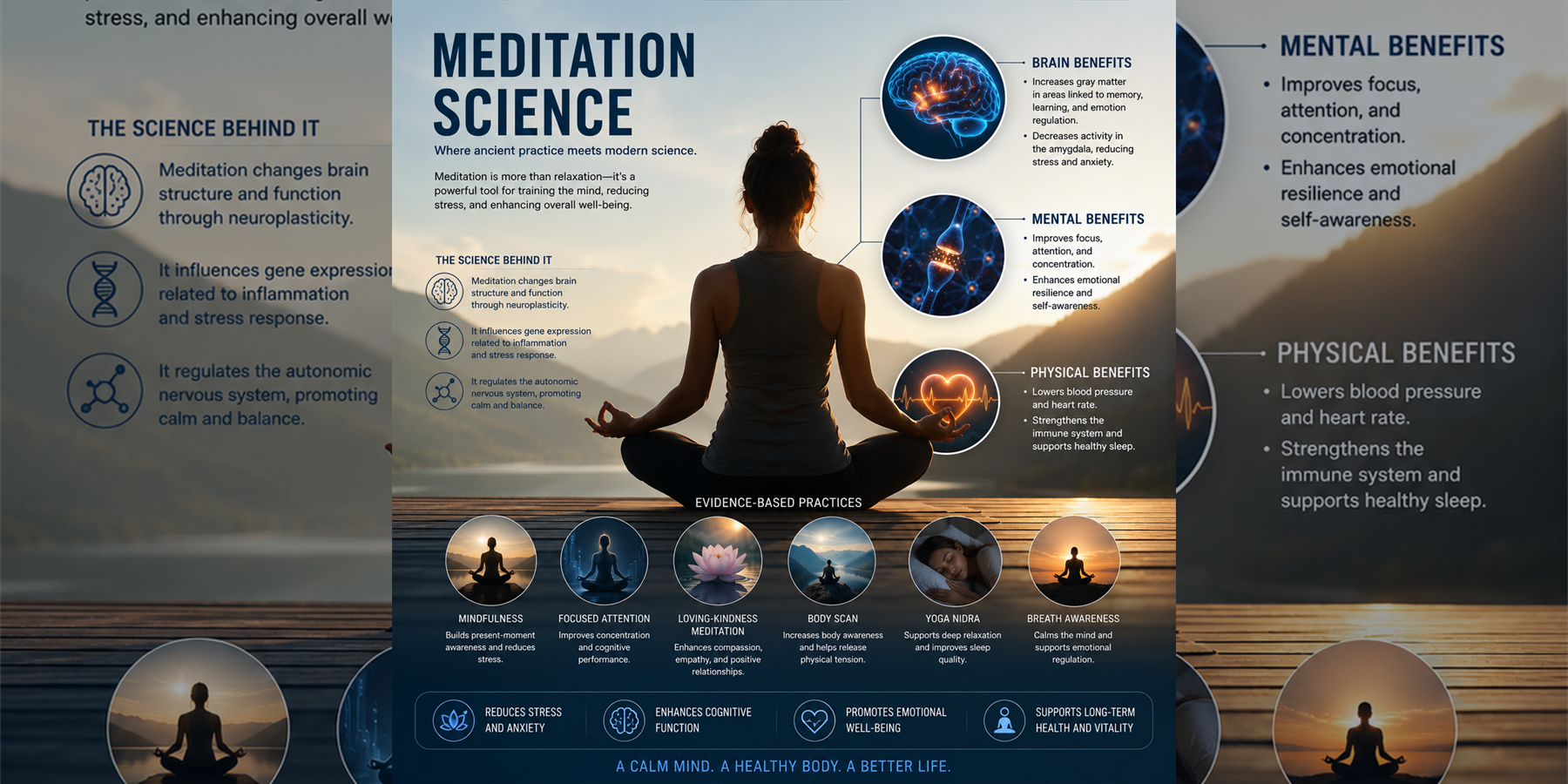
Abstract
Meditation is a family of mental training practices used to cultivate attention, awareness, emotional regulation, and psychological well-being.
Meditation strengthens voluntary attention, present-moment awareness, concentration, and the ability to notice thoughts without being controlled by them.
Practice can shift autonomic balance toward parasympathetic activity, improving heart rate variability, breathing rhythm, stress recovery, and inflammatory regulation.
Meditation is increasingly used for stress management, anxiety, depression, chronic pain, cardiovascular risk, trauma recovery, oncology support, and wellness.
Parts I-II
From ancient contemplative traditions to modern clinical programs, meditation has become a bridge between inner practice and measurable science.
Meditation appears across Buddhism, Hinduism, Taoism, Christianity, Judaism, Islam, and Indigenous traditions, reflecting a universal human drive toward inner cultivation.
Contemporary programs translate contemplative practices into accessible, secular techniques for stress reduction, mental clarity, health promotion, and clinical care.
Maintains nonjudgmental, moment-to-moment awareness of breathing, thoughts, emotions, and bodily sensations as they arise and pass away.
Directs attention to a single object such as the breath, a phrase, a sound, or a visual point. When attention wanders, the practitioner gently returns to the chosen focus.
These practices cultivate warmth toward self and others, support empathic accuracy, and may increase prosocial behavior through insula and anterior cingulate engagement.
Modern secular programs remove religious requirements while preserving practical techniques for stress regulation, emotional balance, and health behavior support.
Part III
Neuroimaging research shows that meditation can change brain structure, function, and connectivity through repeated mental training.
Reduced excessive DMN activity is linked to less mind-wandering, rumination, anxiety, and self-critical thinking.
Greater activity and thickness support attention control, decision-making, working memory, and emotional reappraisal.
Reduced reactivity to emotional stimuli helps lower habitual stress responses and fear-based dysregulation.
Increased gray matter may support memory consolidation and protect against stress-linked neuronal atrophy.
Strengthened error detection, conflict monitoring, and attention regulation improve cognitive control.
Body-scan and mindfulness practices improve interoceptive awareness, pain tolerance, empathy, and internal state tracking.
Part IV
Autonomic balance, breathing, hormone regulation, immune activity, and cardiovascular stress response help explain the broad body-wide benefits.
Parts V-VI
Meditation supports stress reduction, anxiety management, depression relapse prevention, emotional regulation, attention, memory, executive function, and healthy cognitive aging.
MBSR produces consistent reductions in perceived stress by downregulating cortisol, reducing sympathetic reactivity, reframing stressors, and improving coping flexibility.
Reduced HPA axis activation, lower sympathetic nervous system reactivity, and improved appraisal of stressors as less threatening.
Meta-analytic evidence supports improvements in anxiety, depression, and pain, with stress reduction as the most researched benefit.
Meditation can reduce threat appraisal, attentional bias, physiological arousal, worry cycles, and depressive rumination.
Reduced amygdala reactivity and strengthened prefrontal regulation help interrupt worry and avoidance patterns.
MBCT teaches decentering from negative thoughts and can reduce relapse risk in people with recurrent major depression.
Attention training is central to meditation and may improve sustained attention, selective attention, executive control, working memory, and metacognition.
Focused attention practice improves vigilance, reduces mind-wandering, and strengthens conflict monitoring.
Emerging studies suggest meditation may support cognitive reserve, cortical thickness preservation, telomere biology, and white matter integrity.
Part VII
Evidence-based programs are increasingly integrated into mainstream healthcare settings worldwide.
An 8-week group program combining mindfulness meditation, body scan, and gentle yoga for stress, anxiety, pain, and medical illness management.
Combines mindfulness with cognitive therapy to prevent depressive relapse through decentering from depressogenic thought patterns.
Meditation can reduce pain catastrophizing and pain-related disability by changing the emotional suffering dimension of pain.
Programs target stress-mediated hypertension, reduced HRV, inflammatory dysregulation, and cardiovascular stress response.
May reduce cancer-related fatigue, anxiety, depression, sleep disturbance, and quality-of-life burden during treatment.
Trauma-sensitive delivery is important because unmodified practice can temporarily increase symptom intensity in some survivors.
Part VIII
Beyond clinical outcomes, meditation can contribute to compassion, meaning, social connection, and human flourishing.
Practitioners may report expanded self-boundaries, unity, and connection to something larger.
Long-term practice can cultivate more compassionate attitudes, reduced automatic judgment, and deeper understanding of interdependence.
Mindfulness may improve communication, relationship satisfaction, and conflict resolution through emotional regulation.
Regular practice can clarify values, strengthen life purpose, and support existential well-being.
Parts IX-X
A balanced view includes risks, methodological limits, and the next wave of meditation science.
Some meditators experience anxiety, depersonalization, traumatic memory re-emergence, emotional dysregulation, or rare psychosis vulnerability.
Technique variability, expectation effects, self-selection bias, active control issues, dose questions, and limited long-term follow-up complicate interpretation.
7T MRI, EEG source analysis, and fNIRS can reveal meditation-related neural dynamics with greater spatial and temporal precision.
Future programs may tailor technique, dose, and delivery based on genetics, personality, mental health status, and biosensor feedback.
Evidence-based apps are expanding access and may deliver substantial portions of in-person program benefits for depression and anxiety.
Real-time coaching using EEG, heart rate variability, and behavioral data may adapt session quality, difficulty, and guidance.
References
Kabat-Zinn, J. (2013). Full Catastrophe Living: Using the Wisdom of Your Body and Mind to Face Stress, Pain, and Illness (Revised ed.). Bantam Books.
Davidson, R. J., & Goleman, D. (2017). Altered Traits: Science Reveals How Meditation Changes Your Mind, Brain, and Body. Avery.
Goleman, D., & Davidson, R. J. (2018). Meditation and the Neuroscience of Consciousness. Annual Review of Psychology, 69, 21-45.
Tang, Y. Y., Holzel, B. K., & Posner, M. I. (2015). The Neuroscience of Mindfulness Meditation. Nature Reviews Neuroscience, 16(4), 213-225.
Lutz, A., Slagter, H. A., Dunne, J. D., & Davidson, R. J. (2008). Attention Regulation and Monitoring in Meditation. Trends in Cognitive Sciences, 12(4), 163-169.
Holzel, B. K., Carmody, J., Vangel, M., et al. (2011). Mindfulness Practice Leads to Increases in Regional Brain Gray Matter Density. Psychiatry Research: Neuroimaging, 191(1), 36-43.
Goyal, M., Singh, S., Sibinga, E. M. S., et al. (2014). Meditation Programs for Psychological Stress and Well-being: A Systematic Review and Meta-analysis. JAMA Internal Medicine, 174(3), 357-368.
American Psychological Association. (2023). Mindfulness Meditation and Psychological Health. APA.
National Center for Complementary and Integrative Health. (2024). Meditation and Mindfulness: What the Science Says. NIH.
World Health Organization. (2024). Mental Health Promotion and Mind-Body Interventions. WHO.
FAQ
Evidence-based answers to common questions about meditation, the brain, stress, clinical programs, and cognitive performance.
Neuroimaging studies show meditation can increase gray matter density in regions involved in executive function, memory, and interoception, while reducing amygdala reactivity and improving default mode network regulation.
MBSR is an 8-week mindfulness program used for stress, anxiety, depression symptoms, chronic pain, medical illness management, and general wellness support.
Meditation reduces stress by downregulating HPA axis activation, lowering sympathetic arousal, improving breathing regulation, increasing psychological flexibility, and changing threat appraisal.
Mindfulness trains nonjudgmental awareness of present experience, while transcendental meditation typically uses silent mantra repetition to settle attention and produce a relaxation response.
Research suggests meditation can improve sustained attention, executive attention, working memory under stress, metacognition, and reduced mind-wandering, though results vary by practice type and dose.