Computational Chemistry
Models help researchers visualize molecular behavior, estimate target binding, and refine compounds before expensive laboratory work.
Innovative Drug Discovery
Innovative drug discovery leveraging molecular modeling and AI-powered research platforms - transforming how therapeutic compounds are identified, optimized, and developed.
Abstract
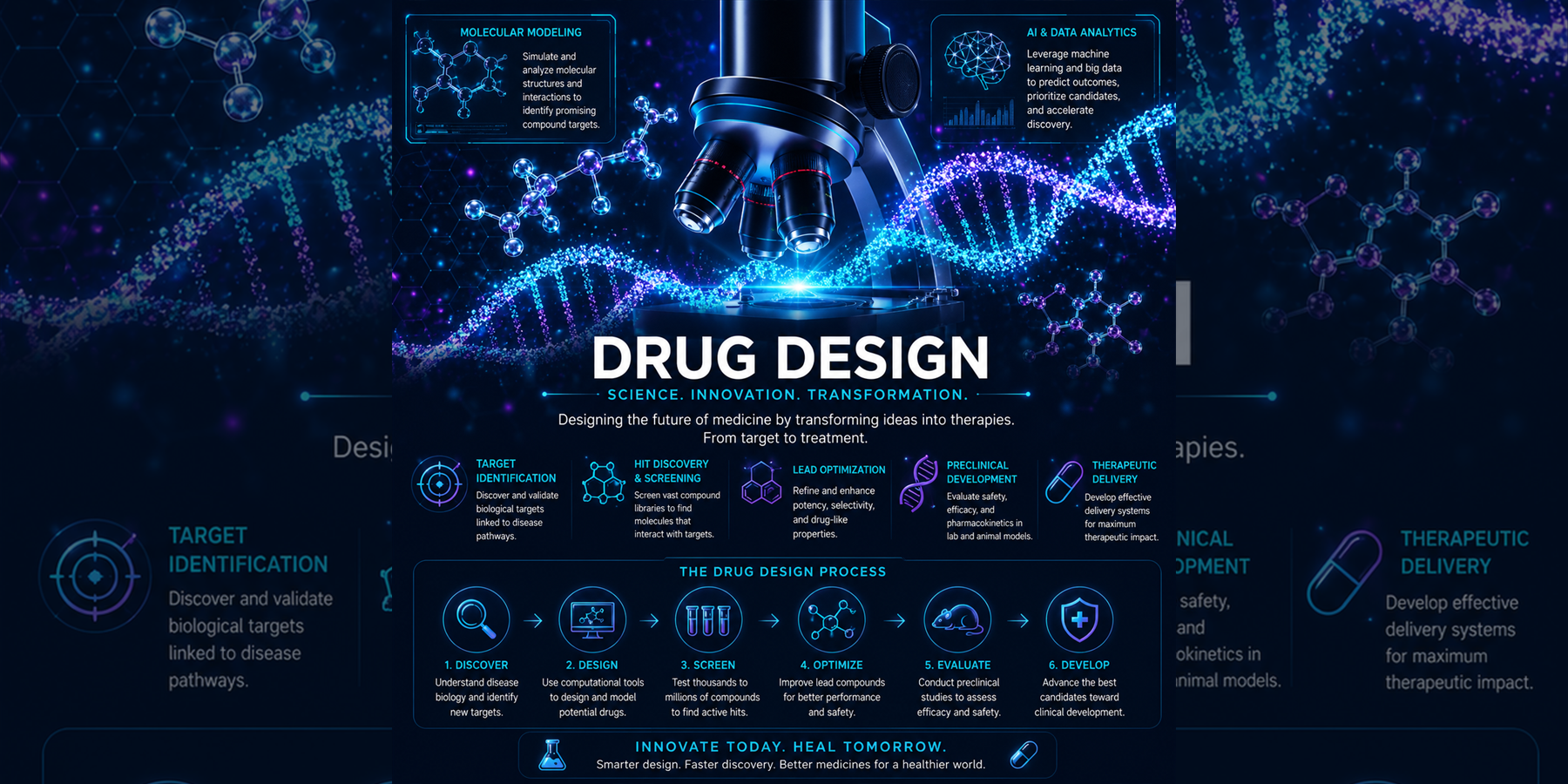
Drug design is a multidisciplinary scientific process focused on developing therapeutic compounds that interact with biological targets to prevent, diagnose, or treat disease.
Models help researchers visualize molecular behavior, estimate target binding, and refine compounds before expensive laboratory work.
Machine learning analyzes biological, chemical, genomic, and clinical datasets at scales impossible for traditional methods alone.
Modern drug design increasingly incorporates genetics, biomarkers, disease subtype, and pharmacogenomic profiles.
Part I
Drug design creates therapeutic molecules capable of interacting with proteins, enzymes, receptors, nucleic acids, and signaling pathways.
Researchers identify a biological molecule or pathway that plays a meaningful role in disease.
Experiments confirm that changing target activity can produce a therapeutic benefit.
Screening identifies molecules with early evidence of useful activity against the target.
Medicinal chemists refine potency, selectivity, stability, pharmacokinetics, and safety.
Candidate compounds are evaluated for biological activity, toxicity, and readiness for human trials.
Human trials, regulatory review, approval, and monitoring determine whether a drug reaches patients.
Part II
Modern drug design is built on understanding molecular interactions between therapeutic compounds and biological targets.
A drug target is a biological molecule whose activity can be modified to produce therapeutic benefit.
Successful design requires detailed knowledge of target structure, target function, disease role, and potential off-target effects.
SAR studies how chemical structure changes alter biological activity, potency, selectivity, and safety.
Small structural changes can improve binding, reduce toxicity, increase solubility, or improve metabolic stability.
SAR guides the iterative optimization of hit compounds into stronger lead candidates.
QSAR models connect molecular descriptors with biological effects to forecast activity before laboratory testing.
Predictive models help prioritize compounds, reduce experimental burden, and guide virtual screening.
QSAR can flag toxicity, poor permeability, and weak target affinity earlier in the discovery process.
Part III
Molecular modeling uses computational techniques to visualize and predict molecular behavior, forming the backbone of rational drug discovery.
Predicts how a drug candidate binds to a target protein and estimates interaction strength.
Models atomic motion over time to understand flexibility, conformational change, and binding stability.
Rapidly evaluates large chemical libraries to identify promising drug candidates for deeper testing.
Part IV
AI transforms each stage of discovery by analyzing complex biological, chemical, genomic, and clinical data.
Machine learning improves activity prediction, drug-target interaction modeling, toxicity forecasting, pharmacokinetic modeling, and clinical outcome prediction.
Deep neural networks improve molecular property prediction, protein structure prediction, drug repurposing, and toxicity prediction.
Graph models represent molecules as connected atoms and bonds, supporting property prediction, lead optimization, molecular generation, and virtual screening.
Part V
Generative AI can create new molecular structures with predefined therapeutic properties and optimize them for multiple drug-like characteristics.
Generative systems create candidate molecules while optimizing multiple properties such as potency, solubility, stability, selectivity, and synthetic feasibility.
Variational autoencoders, generative adversarial networks, diffusion models, and transformer models.
De novo design builds new compounds for a specific biological target instead of only screening existing libraries.
Target affinity, selectivity, low toxicity, improved pharmacokinetics, and manufacturable chemistry.
AI-assisted protein design supports therapeutic antibodies, enzymes, vaccines, and engineered biologics.
Protein stability, binding interface design, antigen targeting, enzyme optimization, and biologic drug discovery.
Part VI
Finding the right biological target and optimizing lead compounds are critical steps now accelerated by AI-assisted workflows.
AI analyzes genomic datasets, proteomic datasets, disease pathways, and biomedical literature to identify disease-associated proteins and pathways.
AI-assisted lead discovery combines virtual screening, molecular docking, and machine learning to identify stronger candidates efficiently.
Medicinal chemists optimize structural modifications affecting potency, selectivity, pharmacokinetics, and toxicity.
Part VII
Successful candidates need favorable absorption, distribution, metabolism, excretion, and toxicity profiles.
How the drug is taken up into the body.
How the drug spreads through bodily tissues.
How the drug is chemically transformed.
How the drug is eliminated from the body.
Potential harmful effects on the body.
Machine learning predicts oral bioavailability, blood-brain barrier penetration, metabolic stability, toxicity risk, and drug-drug interactions.
Part VIII
AI-driven and computational drug design approaches are being applied across a wide range of disease areas.
Precision oncology uses molecular profiling and AI-guided design to develop targeted therapies against cancer-specific mutations.
Computational drug design helps identify antiviral and antimicrobial candidates during urgent public health needs.
Molecular modeling and AI help identify targets for Alzheimer's, Parkinson's, epilepsy, and other neurodegenerative disorders.
AI-assisted approaches help identify treatments for conditions that traditionally receive limited pharmaceutical investment.
AI systems identify new uses for existing drugs by analyzing molecular pathways and clinical data.
Computational methods accelerate discovery of cardiovascular compounds by modeling receptor interactions and cardiac pathways.
Part IX
AI-assisted drug design is powerful, but data quality, interpretability, regulation, and chemical novelty remain major issues.
Incomplete or biased datasets can reduce predictive accuracy and introduce systematic errors.
Deep learning systems can behave as black boxes, making predictions difficult to explain to researchers and regulators.
Regulatory agencies continue developing frameworks for evaluating AI-assisted methods and AI-designed candidates.
AI-guided robotic systems may conduct experiments continuously and optimize research workflows.
Advanced AI can integrate biomedical literature, genomic data, and molecular design into unified discovery platforms.
Patient-specific computational models may predict therapeutic responses before treatment initiation.
Scientific References
Abbasi, K., et al. (2025). Computational Drug Design in the Artificial Intelligence Era. Pharmacological Reviews.
Dara, S., et al. (2021). Machine Learning in Drug Discovery: A Review. Artificial Intelligence Review, 54, 1947-1999.
Das, U., et al. (2025). Generative AI for Drug Discovery and Protein Design. Cell Reports Physical Science.
Ferreira, F. J. N., et al. (2025). AI-Driven Drug Discovery: A Comprehensive Review. ACS Omega.
Jayatunga, M. K. P., et al. (2022). AI in Small-Molecule Drug Discovery: A Coming Wave? Nature Reviews Drug Discovery, 21, 175-176.
Paul, D., et al. (2020). Artificial Intelligence in Drug Discovery and Development. Drug Discovery Today, 25(7), 1315-1325.
Sadybekov, A. V., et al. (2023). Computational Approaches Streamlining Drug Discovery. Nature, 616, 673-685.
Serrano, D. R., et al. (2024). Artificial Intelligence Applications in Drug Discovery and Development. Pharmaceutics, 16(10), 1328.
Zheng, Y., et al. (2025). Large Language Models for Drug Discovery and Development. Briefings in Bioinformatics.
Zhou, G., et al. (2024). An Artificial Intelligence Accelerated Virtual Screening Framework for Drug Discovery. Nature Communications, 15, 7865.
FAQ
Evidence-based answers to common questions on molecular modeling, AI discovery, and ADMET.
Rational drug design uses knowledge of disease biology, molecular targets, and compound structure to design therapies more deliberately than trial-and-error screening alone.
AI helps identify targets, screen compounds, predict toxicity, optimize leads, repurpose drugs, design molecules, and analyze biomedical data at large scale.
ADMET stands for absorption, distribution, metabolism, excretion, and toxicity. Poor ADMET properties cause many drug candidates to fail, so early prediction reduces risk.
Fragment-based discovery starts with small chemical fragments that weakly bind targets, then grows or links them into stronger lead compounds.
Generative AI creates new molecular structures with desired properties, helping researchers explore chemical space beyond existing compound libraries.