Early Development
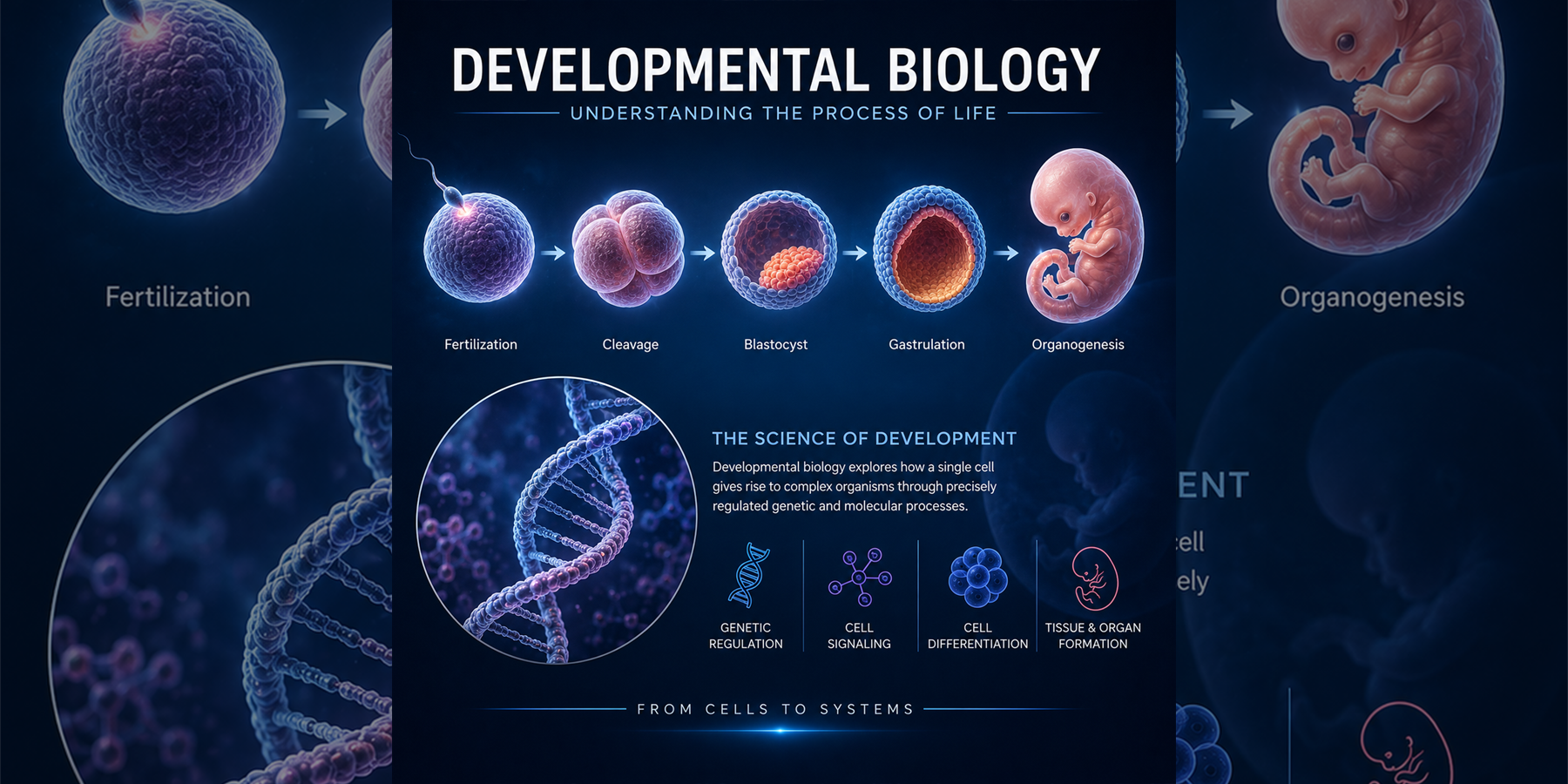
Fertilization, cleavage, blastulation, gastrulation, and germ layer formation establish the blueprint for the body.
Mechanisms of Growth, Differentiation & Formation
Exploring how a single fertilized cell gives rise to the extraordinary complexity of tissues, organs, and organisms through precise genetic, molecular, and cellular programs.
Abstract
Developmental biology studies how multicellular organisms grow, develop, and maintain structural organization from fertilization through adulthood.
Fertilization, cleavage, blastulation, gastrulation, and germ layer formation establish the blueprint for the body.
Nearly all cells carry the same DNA, yet gene regulation and epigenetic control create specialized cell types and tissues.
Developmental principles guide regenerative medicine, tissue engineering, organoids, stem cell therapy, and disease modeling.
Part I
The field emerged from embryology and now uses molecular genetics and cellular biology to investigate development in precise detail.
Advances in developmental biology influence regenerative medicine, gene therapy, reproductive medicine, cancer research, tissue engineering, and evolutionary biology.
Part II
Development begins with fertilization and proceeds through coordinated stages that create a multicellular embryo.
The zygote undergoes rapid mitotic divisions called cleavage, increasing cell number while preserving overall embryo size.
The blastocyst contains the inner cell mass, which develops into the embryo proper, and the trophectoderm, which contributes to placenta formation.
Part III
Gastrulation reorganizes the embryo into three primary germ layers that form all future tissues and organs.
Part IV
Identical genetic information gives rise to hundreds of specialized cell types through selective gene activation.
Specialized for signal transmission through electrical impulses and chemical synapses.
Specialized for contraction, force generation, and movement.
Specialized for metabolic processing, detoxification, bile production, and protein synthesis.
Specialized for oxygen transport, immunity, clotting, and inflammatory defense.
Transcription factors, enhancers, repressors, and signaling cues coordinate gene expression programs that establish stable cell identities.
DNA methylation, histone modification, chromatin remodeling, and non-coding RNAs control whether developmental genes remain active, silent, or poised for activation.
Part V
Simple embryonic structures are transformed into complex three-dimensional organ systems.
Neurulation folds the neural plate into a tube that produces the brain and spinal cord.
Cardiogenesis forms the cardiovascular system through looping, septation, and valve formation.
Limb buds establish arms and legs through coordinated growth and positional patterning signals.
Optic vesicle induction from neuroectoderm produces specialized visual structures.
Part VI
Conserved molecular cascades coordinate cell communication throughout embryogenesis.
FGF promotes cell proliferation and survival, especially in limb outgrowth, brain and neural development, angiogenesis, wound healing, and repair.
Associated disorders: Achondroplasia, Apert syndrome, and various cancers.
Coordinates axis formation, cell fate, stem cell maintenance, and tissue patterning across animal development.
Controls lateral inhibition, cell boundary specification, differentiation timing, and tissue organization.
Guides tissue patterning, bone development, and dorsal-ventral organization.
Controls limb patterning, neural tube organization, and many organ development programs.
Part VII
Cells with self-renewal and differentiation potential form the basis of development, maintenance, and regenerative medicine.
Can generate an entire organism including extraembryonic tissues. Examples include the zygote and early blastomeres.
Can form all body cell types. Examples include embryonic stem cells and induced pluripotent stem cells.
Can generate multiple related cell types within a lineage, such as hematopoietic and neural stem cells.
Derived from the blastocyst inner cell mass and valuable for developmental research, drug testing, disease modeling, and cell replacement therapy.
Adult cells reprogrammed into pluripotency through Yamanaka factors: Oct4, Sox2, Klf4, and c-Myc.
Salamanders regenerate limbs, zebrafish regenerate cardiac muscle, and planarians can regenerate from small tissue fragments.
Part VIII
Developmental biology informs the understanding and treatment of congenital conditions and degenerative diseases.
Maternal nutrition, environmental exposures, stress, and epigenetic programming influence long-term health outcomes.
Developmental biology supports stem cell therapies, tissue engineering, organoid strategies, and cell replacement approaches for Parkinson's disease and diabetes.
Part IX
Developmental processes shape evolution, and evolutionary forces have sculpted developmental programs.
Control anterior-posterior body patterning from flies to humans and are conserved across more than 500 million years of evolution.
Wnt functions in axis formation and cell fate; Notch coordinates lateral inhibition and cell boundary specification.
Eye and brain development genes shared between Drosophila and vertebrates suggest common evolutionary origin.
Changes in developmental timing, spatial expression, and regulatory networks generate anatomical diversity and adaptation.
Part X
Emerging technologies are accelerating the understanding of developmental mechanisms and regenerative applications.
Analyzes gene expression at individual cell resolution to reveal rare progenitors and cellular heterogeneity.
Maps gene expression within intact tissues while preserving spatial context.
Creates miniature organ-like structures from stem cells for disease modeling, drug testing, and therapeutic research.
Enables precise manipulation of developmental genes and accurate disease models.
Supports developmental modeling, image analysis, gene network prediction, and morphogenesis simulation.
Creates embryo-like structures from stem cells for studying the earliest stages of development.
References
Gilbert, S. F., & Barresi, M. J. F. (2023). Developmental Biology (13th ed.). Sinauer Associates.
Wolpert, L., Tickle, C., & Arias, A. M. (2019). Principles of Development (6th ed.). Oxford University Press.
Slack, J. M. W. (2018). Essential Developmental Biology (4th ed.). Wiley-Blackwell.
Nusslein-Volhard, C., & Wieschaus, E. (1980). Mutations Affecting Segment Number and Polarity in Drosophila. Nature, 287, 795-801.
Takahashi, K., & Yamanaka, S. (2006). Induction of Pluripotent Stem Cells from Mouse Embryonic and Adult Fibroblast Cultures by Defined Factors. Cell, 126(4), 663-676.
Yamanaka, S. (2020). Pluripotent Stem Cell-Based Cell Therapy - Promise and Challenges. Cell Stem Cell, 27(4), 523-531.
Clevers, H. (2016). Modeling Development and Disease with Organoids. Cell, 165(7), 1586-1597.
Davidson, E. H. (2010). Emerging Properties of Animal Gene Regulatory Networks. Nature, 468(7326), 911-920.
Briscoe, J., & Small, S. (2015). Morphogen Rules: Design Principles of Gradient-Mediated Embryo Patterning. Development, 142(23), 3996-4009.
National Institute of General Medical Sciences. (2024). Developmental Biology Fact Sheet. U.S. National Institutes of Health.
FAQ
Evidence-based answers to common questions on embryogenesis, differentiation, signaling, and Evo-Devo.
Developmental biology is the study of how organisms grow from a single cell into organized multicellular systems through gene regulation, signaling, cell movement, differentiation, and tissue formation.
Gastrulation reorganizes the embryo into ectoderm, mesoderm, and endoderm. These germ layers form the foundation for future tissues and organs.
Cells differentiate when specific genes are activated or silenced by transcription factors, signaling pathways, epigenetic marks, and gene regulatory networks.
Major pathways include Wnt, Hedgehog, Notch, BMP, and FGF. These pathways coordinate cell fate, growth, tissue patterning, and organ formation.
Evo-Devo explores how changes in developmental programs generate evolutionary novelty, including conserved toolkit genes, heterochrony, modularity, and regulatory evolution.