Structure and Function
Cells organize membranes, organelles, genetic information, and cytoskeletal systems into living, responsive biological units.
Molecular Basis of Life
Exploring the molecular, biochemical, and genetic mechanisms governing cellular organization, metabolism, communication, growth, division, differentiation, and the cellular basis of human disease.
Abstract
Cell biology studies cells as the fundamental structural and functional units of life, connecting molecular biology, genetics, biochemistry, physiology, biotechnology, and medicine.
Cells organize membranes, organelles, genetic information, and cytoskeletal systems into living, responsive biological units.
Metabolism, ATP generation, signaling pathways, and receptor systems coordinate cellular activity and tissue-level responses.
Cancer, neurodegeneration, metabolic disorders, and infection are rooted in altered cellular processes and molecular pathways.
Part I
Cell biology, also known as cytology, asks how cells function, communicate, divide, differentiate, and cause disease when cellular systems fail.
Part II
Cells are classified into fundamental categories distinguished by nuclear organization, internal complexity, and specialized structures.
Found in bacteria and archaea, these cells lack a membrane-bound nucleus and have streamlined internal organization.
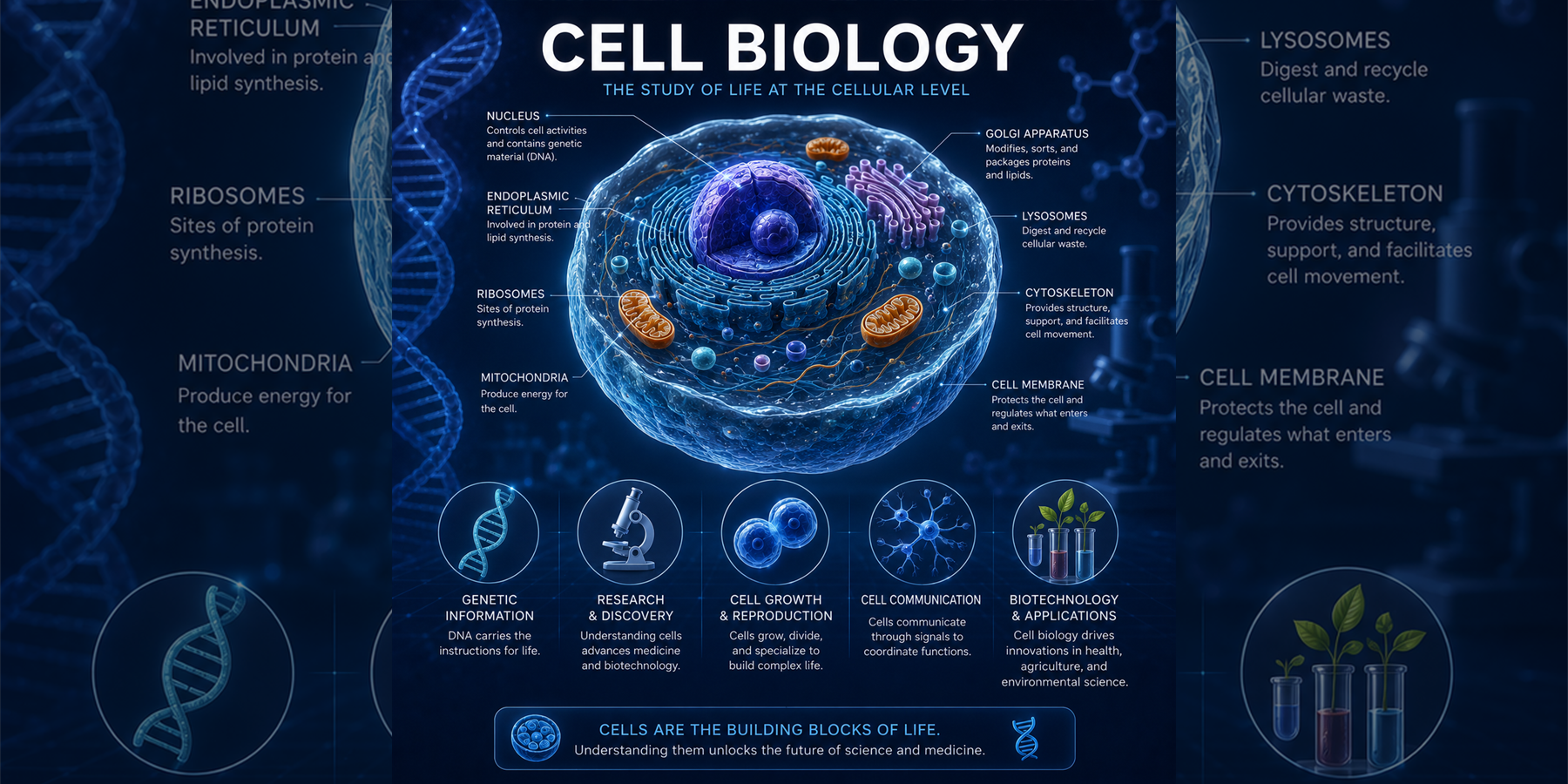
Eukaryotic cells contain a membrane-bound nucleus and specialized organelles that divide cellular labor.
Compartmentalization allows eukaryotic cells to regulate metabolism, gene expression, protein processing, signaling, and specialized tissue functions.
The plasma membrane provides selective permeability, signaling capacity, and structural integrity.
Glycoproteins and glycolipids help cells recognize each other, adhere to tissues, and communicate with the immune system.
Part III
Membrane-bound compartments carry out specialized functions, enabling division of labor within eukaryotic cells.
The nucleus houses genetic material and controls gene expression, RNA synthesis, and coordination of the cell cycle.
DNA storage and protection, gene regulation, mRNA transcription, rRNA production via the nucleolus, and cell cycle coordination.
Mitochondria generate most cellular ATP through oxidative phosphorylation and also participate in apoptosis and metabolic regulation.
Mitochondrial dysfunction contributes to metabolic disease, neurodegeneration, aging biology, and inherited mitochondrial disorders.
The rough ER supports protein synthesis and folding, while the smooth ER supports lipid synthesis, calcium storage, and detoxification.
ER stress and misfolded protein accumulation are important in metabolic disease, neurodegeneration, and inflammatory disorders.
The Golgi modifies, packages, and directs proteins and lipids to their final cellular or extracellular destinations.
Protein glycosylation, vesicle trafficking, secretion, membrane renewal, and lysosome enzyme sorting.
Lysosomes degrade damaged organelles, macromolecules, and cellular waste using acidic enzymes.
Defective lysosomal enzymes can cause storage diseases and impaired cellular clearance.
Part IV
Metabolism includes the biochemical reactions that break down nutrients, build cellular components, and generate ATP.
Breakdown of carbohydrates, fats, and proteins into simpler components releases chemical energy captured as ATP.
Cells build proteins, nucleic acids, lipids, and other macromolecules from simpler precursors, consuming ATP.
ATP hydrolysis drives muscle contraction, protein synthesis, active transport, cell signaling, DNA replication, and ion pumping.
Occurs in the cytoplasm, splitting glucose into two pyruvate molecules and generating 2 ATP plus 2 NADH per glucose.
Occurs in the mitochondrial matrix, oxidizing acetyl-CoA and generating electron carriers for ATP production.
Occurs at the inner mitochondrial membrane, where the electron transport chain and ATP synthase produce most cellular ATP.
Part V
Cells communicate through molecular signals that regulate growth, differentiation, metabolism, and immune responses.
Insulin, estrogen, testosterone, and cortisol support long-distance endocrine signaling.
Dopamine, serotonin, acetylcholine, and GABA support rapid synaptic communication.
Interleukins, interferons, TNF-alpha, EGF, VEGF, PDGF, and NGF regulate immune and local tissue signaling.
G-protein coupled receptors activate intracellular G-proteins and second messengers such as cAMP, IP3, and DAG.
RTKs dimerize after ligand binding and trigger downstream MAPK and PI3K pathway activation.
Ligand binding directly opens ion channels for rapid electrical signaling in neurons and muscle cells.
Regulates cell proliferation, differentiation, and survival.
Controls metabolism, cell growth, and apoptosis resistance.
Coordinate immune signaling, cytokine responses, development, stem cell renewal, and cancer biology.
Part VI
Growth, repair, reproduction, and specialized cell formation require tightly regulated cell cycle control.
Cells grow and synthesize proteins and organelles needed for DNA replication.
Chromosomal DNA is duplicated and newly replicated DNA is packaged with histones.
Cells prepare for mitosis, check DNA, repair damage, and assemble mitotic machinery.
Nuclear and cytoplasmic division produces two genetically identical daughter cells.
Two divisions generate four haploid gametes, supporting genetic diversity through crossing-over and independent assortment.
Genetically identical cells acquire unique functions through selective gene expression and epigenetic programming.
Part VII
Stem cells have self-renewal and differentiation potential, forming the foundation of regenerative medicine and personalized therapies.
Can form an entire organism including placental tissues; found in the fertilized egg and early blastomeres.
Can generate nearly all cell types except placental tissues, including embryonic stem cells and iPSCs.
Can produce multiple related cell types within a lineage, such as hematopoietic and neural stem cells.
Induced pluripotent stem cells are adult somatic cells reprogrammed with defined factors for disease modeling and personalized therapy research.
Cell therapies, tissue engineering, disease modeling, and drug screening use stem cells and organoids to model and repair human biology.
Patient-specific cells can reduce embryo-related ethical concerns and support personalized disease models.
Part VIII
Most human diseases have origins in cellular dysfunction, making cell biology central to pathology and therapeutics.
Uncontrolled proliferation arises from mutations in proto-oncogenes, tumor suppressor genes, and DNA repair genes.
Neuronal loss is driven by protein aggregation, mitochondrial dysfunction, oxidative stress, and impaired cellular clearance.
Disrupted metabolic pathways affect glucose homeostasis, lipid metabolism, insulin signaling, and energy production.
Pathogens hijack host cellular machinery for entry, replication, immune evasion, and spread.
Part IX
Revolutions in imaging, sequencing, and computation are driving unprecedented insights into cellular life.
Labels specific proteins or organelles with fluorescent tags for real-time visualization of cellular dynamics.
Optical sectioning enables high-resolution three-dimensional reconstruction of cellular architecture.
STED, STORM, and PALM can resolve structures below the traditional diffraction limit.
TEM and SEM reveal ultrastructural details at nanometer resolution.
Reveals near-atomic structures of cellular machines in a native-like state.
Sequencing and computational models map gene expression, proteins, metabolites, cell states, and disease transitions.
Part X
Emerging technologies are transforming medicine, biotechnology, and our understanding of life.
Miniature organ-like structures support personalized drug testing, disease modeling, and future repair strategies.
Engineered cells can produce therapeutics, act as biosensors, or function as autonomous delivery systems.
Base editing, prime editing, and next-generation tools enable precise correction of disease-causing mutations.
CAR-T cells, tumor-infiltrating lymphocytes, and stem cell transplantation redirect cellular functions against disease.
Virtual cell models simulate molecular networks, metabolic flux, and behavior for drug screening and hypothesis testing.
Scientific References
Alberts, B., Johnson, A., Lewis, J., et al. (2022). Molecular Biology of the Cell (7th ed.). Garland Science.
Cooper, G. M., & Hausman, R. E. (2023). The Cell: A Molecular Approach (9th ed.). Oxford University Press.
Lodish, H., Berk, A., Kaiser, C. A., et al. (2021). Molecular Cell Biology (9th ed.). W.H. Freeman.
Karp, G. (2023). Cell and Molecular Biology: Concepts and Experiments (9th ed.). Wiley.
Watson, J. D., Baker, T. A., Bell, S. P., et al. (2022). Molecular Biology of the Gene (8th ed.). Pearson.
Takahashi, K., & Yamanaka, S. (2006). Induction of Pluripotent Stem Cells from Mouse Embryonic and Adult Fibroblast Cultures by Defined Factors. Cell, 126(4), 663-676.
Palade, G. E. (1975). Intracellular Aspects of the Process of Protein Synthesis. Science, 189(4200), 347-358.
National Institute of General Medical Sciences. (2024). Cell Biology and Human Health Resources.
National Human Genome Research Institute. (2024). Genomics and Cellular Function.
Pollard, T. D., Earnshaw, W. C., Lippincott-Schwartz, J., & Johnson, G. (2022). Cell Biology (4th ed.). Elsevier.
FAQ
Evidence-based answers to common questions on cell structure, communication, energy, and research technologies.
Eukaryotic cells include the plasma membrane, nucleus, mitochondria, endoplasmic reticulum, Golgi apparatus, lysosomes, cytoskeleton, and ribosomes. Specialized cells vary by function.
Cells communicate through hormones, neurotransmitters, cytokines, growth factors, receptors, second messengers, and signaling pathways such as MAPK, PI3K, JAK/STAT, and Wnt.
Cell division proceeds through G1, S, G2, and M phases and is regulated by checkpoints that monitor growth, DNA replication, and chromosome separation.
Cells generate ATP through glycolysis, the citric acid cycle, and oxidative phosphorylation. Plant cells and algae also use photosynthesis to convert light into chemical energy.
Modern cell biology uses fluorescence microscopy, confocal microscopy, super-resolution imaging, electron microscopy, cryo-electron tomography, genomics, proteomics, bioinformatics, and AI.