Abnormal Growth
Cancer cells disable normal controls over growth, division, differentiation, and programmed cell death.
Biology | Treatment | Future
Comprehensive exploration of cancer biology, molecular mechanisms, diagnostic strategies, conventional treatments, targeted therapies, immunotherapy, and AI-driven precision oncology.
Abstract
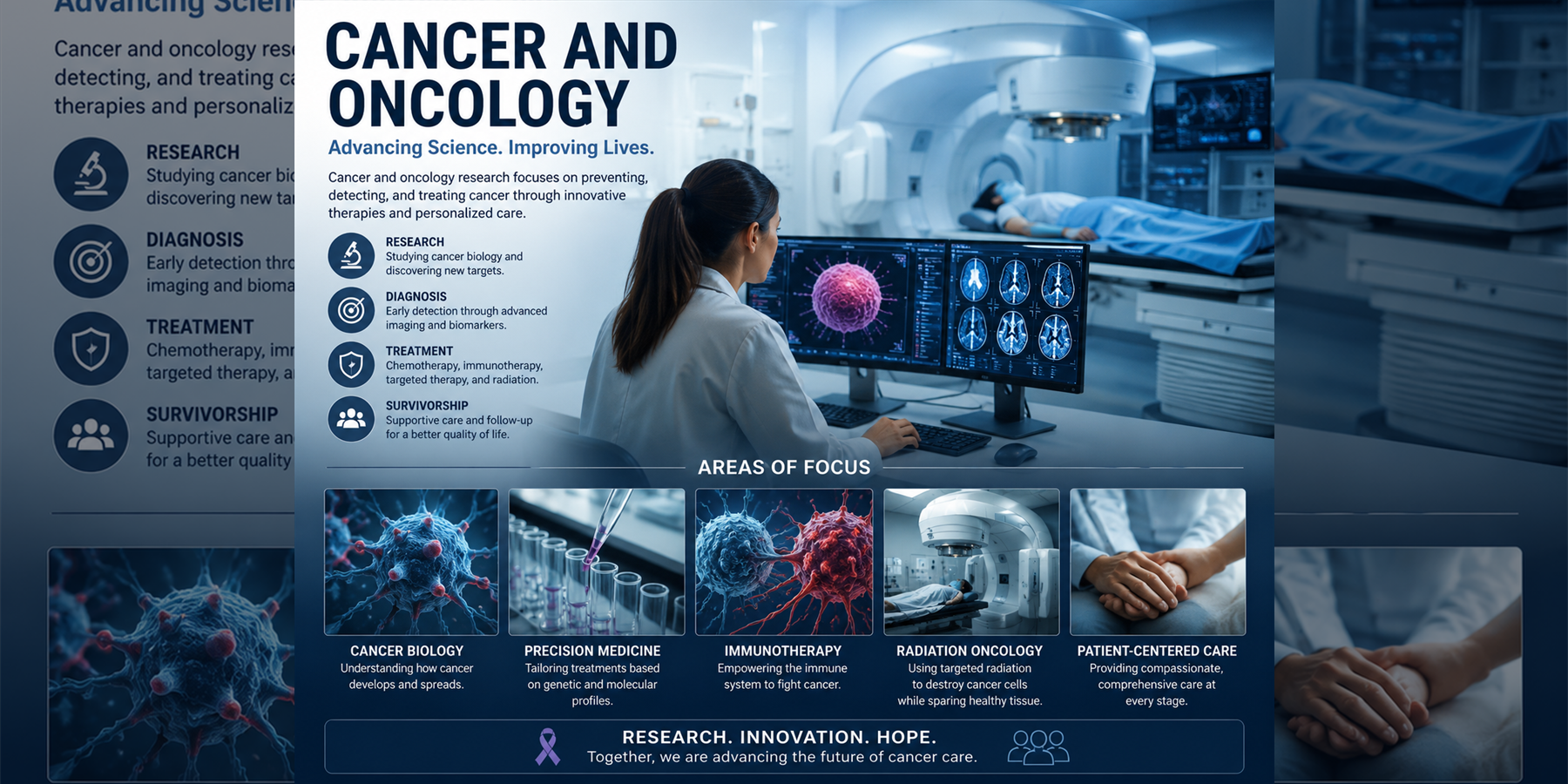
Cancer is a group of diseases characterized by uncontrolled cell growth, abnormal proliferation, tissue invasion, and metastasis. Advances in molecular biology, genomics, immunology, and precision medicine are reshaping diagnosis and treatment.
Cancer cells disable normal controls over growth, division, differentiation, and programmed cell death.
Modern oncology combines surgery, radiation, chemotherapy, targeted therapy, immunotherapy, hormone therapy, and cellular therapies.
AI, liquid biopsy, gene editing, and personalized vaccines are accelerating earlier detection and more individualized treatment.
Parts I-II
Cancer is fundamentally a disease of altered DNA, driven by mutations in oncogenes, tumor suppressors, and genome stability pathways.
Healthy cells proliferate only in response to regulated physiological signals.
Normal mitosis maintains tissue homeostasis and prevents uncontrolled expansion.
Cells specialize into tissue-specific functional types with defined roles.
Apoptosis removes damaged or unwanted cells before they threaten tissue health.
Single nucleotide substitutions can alter protein function, such as KRAS G12D activation.
Frameshift mutations disrupt open reading frames and often inactivate tumor suppressors.
Translocations can create fusion oncoproteins such as BCR-ABL in chronic myeloid leukemia.
Amplifications or deletions alter dosage-sensitive regulators such as HER2, MYC, PTEN, and CDKN2A.
Drives proliferation through MAPK and PI3K pathways in pancreatic, lung, and colorectal cancer.
Amplifies cell growth programs and accelerates cell-cycle entry in lymphoma, breast, and lung cancer.
V600E activates the MEK-ERK cascade and can be targeted by BRAF inhibitors.
RTK amplification drives PI3K/AKT signaling and is targeted by HER2-directed therapies.
The guardian of the genome triggers DNA repair and apoptosis in response to cellular stress.
Controls the G1-S checkpoint; loss allows unrestrained cell-cycle progression.
Support homologous recombination repair; germline mutations increase hereditary breast and ovarian cancer risk.
Regulates Wnt signaling and often initiates the colorectal adenoma-carcinoma sequence when lost.
Part III
The hallmarks framework describes the defining biological capabilities acquired during malignant transformation.
Cancer cells generate their own growth signals or become hypersensitive to mitogenic stimulation.
Checkpoint pathways such as RB and TP53 are disabled, allowing excessive proliferation.
Anti-apoptotic signals allow survival despite severe genomic damage.
Telomerase activation allows cancer cells to bypass normal limits on cell division.
Tumors recruit blood vessels through VEGF and related pathways to support continued growth.
Cancer cells acquire motility, invade tissues, and seed distant metastatic niches.
Checkpoint ligands, suppressive cells, and tumor microenvironments weaken anti-tumor immunity.
Chronic inflammation supplies growth factors, survival signals, and angiogenic support.
Part IV
Common malignancies differ in incidence, molecular subtypes, risk factors, treatment approaches, and screening recommendations.
Breast cancer includes HR+/HER2-, HER2+, triple-negative, lobular, and ductal subtypes. Care may include surgery, radiation, hormone therapy, HER2-targeted therapy, chemotherapy, CDK4/6 inhibitors, and immunotherapy.
BRCA1/2 mutations, estrogen exposure, obesity, alcohol, dense breast tissue, mammography, and MRI for high-risk individuals.
Lung cancer care increasingly relies on molecular testing for EGFR, ALK, ROS1, BRAF, MET, RET, NTRK, PD-L1, and tumor mutational burden.
Smoking prevention, CT screening in high-risk groups, biopsy, staging, genomic profiling, targeted therapy, immunotherapy, radiation, and surgery when appropriate.
Colorectal cancer can arise through the adenoma-carcinoma sequence, Lynch syndrome, APC loss, KRAS pathway activation, and microsatellite instability.
Colonoscopy with polypectomy can prevent many cancers by removing precursor lesions before malignant transformation.
Prostate cancer management spans surveillance, surgery, radiation, androgen deprivation therapy, AR pathway inhibitors, radiopharmaceuticals, and PARP inhibitors for selected DNA repair defects.
Risk stratification combines PSA, imaging, biopsy grade, staging, family history, and molecular biomarkers.
Blood cancers often use flow cytometry, cytogenetics, NGS, targeted inhibitors, monoclonal antibodies, stem cell transplantation, bispecific antibodies, and CAR-T therapy.
BCR-ABL targeted therapy in CML transformed a previously fatal disease into a highly manageable condition for many patients.
Part V
Up to half of cancers are attributable to modifiable risk factors, making prevention one of the strongest tools for lowering the global cancer burden.
Part VI
Accurate diagnosis and staging combine imaging, pathology, biomarkers, and molecular profiling.
TNM describes tumor size, lymph node involvement, and metastasis. Stage I is localized, Stage II is larger or regional, Stage III is extensive regional disease, and Stage IV involves distant metastasis.
Parts VII-IX
Oncology increasingly combines established pillars of care with biomarker-driven targeted treatments and immune therapies.
Curative resection, cytoreduction, prophylactic surgery, and minimally invasive robotic approaches.
External beam radiation, stereotactic radiosurgery, proton therapy, and brachytherapy.
Alkylating agents, antimetabolites, taxanes, vinca alkaloids, and anthracyclines.
SERMs, aromatase inhibitors, androgen deprivation therapy, and LHRH agonists or antagonists.
Trastuzumab, pertuzumab, lapatinib, T-DM1, and trastuzumab deruxtecan transformed HER2-positive disease.
Erlotinib, gefitinib, osimertinib, and cetuximab target EGFR-driven tumors.
Combination BRAF and MEK blockade delays resistance in BRAF-mutant melanoma and other cancers.
Crizotinib, alectinib, brigatinib, lorlatinib, and entrectinib target rearranged lung cancers.
Olaparib, rucaparib, niraparib, and talazoparib exploit synthetic lethality in BRCA-deficient cells.
Palbociclib, ribociclib, and abemaciclib improve outcomes in HR-positive breast cancer.
Pembrolizumab and nivolumab release T-cell brakes across melanoma, lung cancer, MSI-H tumors, Hodgkin lymphoma, and other cancers.
Atezolizumab, durvalumab, and avelumab support treatment in lung, bladder, triple-negative breast, Merkel cell, and liver cancer.
Ipilimumab and tremelimumab can enhance immune priming, often in combination with PD-1 pathway blockade.
CD19-directed CAR-T therapy for relapsed or refractory B-ALL and diffuse large B-cell lymphoma.
CD19-directed CAR-T therapy with strong response rates in large B-cell lymphoma.
BCMA-directed CAR-T therapies for heavily pretreated multiple myeloma.
Neoantigen vaccines, bispecific T-cell engagers, NK-cell therapies, TIL therapy, oncolytic viruses, and therapeutic cancer vaccines.
Part X
The next decade of oncology will be shaped by AI, multi-omics, liquid biopsy, personalized vaccines, gene editing, and global cancer equity.
AI supports melanoma detection, lung nodule analysis, tumor grading, drug discovery, and faster diagnosis.
Genomics, transcriptomics, proteomics, and metabolomics create comprehensive cancer portraits.
Multi-cancer early detection blood tests may identify cancer before symptoms appear in high-risk populations.
mRNA neoantigen vaccines encode patient-specific tumor mutations to induce durable anti-tumor immunity.
CRISPR-based approaches can enhance CAR-T manufacturing and may eventually target tumor cells directly.
Scalable diagnostics, affordable biosimilars, and capacity-building are essential because most deaths occur where access is limited.
References
Hanahan, D., & Weinberg, R. A. (2011). Hallmarks of Cancer: The Next Generation. Cell, 144(5), 646-674.
Hanahan, D. (2022). Hallmarks of Cancer: New Dimensions. Cancer Discovery, 12(1), 31-46.
National Cancer Institute. (2024). Cancer Statistics and Treatment Resources. U.S. National Institutes of Health.
American Cancer Society. (2024). Cancer Facts & Figures 2024. ACS.
DeVita, V. T., Lawrence, T. S., & Rosenberg, S. A. (2023). Cancer: Principles & Practice of Oncology. Wolters Kluwer.
Vogelstein, B., Papadopoulos, N., Velculescu, V. E., et al. (2013). Cancer Genome Landscapes. Science, 339(6127), 1546-1558.
Topalian, S. L., Drake, C. G., & Pardoll, D. M. (2015). Immune Checkpoint Blockade. Cancer Cell, 27(4), 450-461.
June, C. H., O'Connor, R. S., Kawalekar, O. U., et al. (2018). CAR T Cell Immunotherapy for Human Cancer. Science, 359(6382), 1361-1365.
Sung, H., Ferlay, J., Siegel, R. L., et al. (2021). Global Cancer Statistics 2020. CA: A Cancer Journal for Clinicians, 71(3), 209-249.
World Health Organization. (2024). Cancer Fact Sheets and Global Cancer Control Resources. WHO.
FAQ
Evidence-based answers to common questions about cancer biology, diagnosis, precision oncology, and immunotherapy.
Cancer arises when genetic and epigenetic changes activate oncogenes, disable tumor suppressors, impair DNA repair, and allow cells to proliferate, survive, invade, and evade immune control.
Hallmarks include sustained proliferation, growth suppressor evasion, resistance to cell death, replicative immortality, angiogenesis, invasion, metastasis, inflammation, and immune evasion.
Immunotherapy uses the immune system to recognize and attack cancer, including checkpoint inhibitors, CAR-T cells, bispecific antibodies, vaccines, and tumor-infiltrating lymphocyte therapy.
Precision oncology matches tumor molecular profiles to targeted treatments, immunotherapy markers, clinical trials, and individualized care strategies.
AI analyzes radiology, pathology, EHR, and molecular data, while genomics identifies driver mutations, resistance patterns, hereditary risk, and biomarkers for targeted therapy.