Brain-Based Understanding
Neuroimaging, genetics, inflammation, connectomics, and molecular neuroscience help explain psychiatric risk and treatment response.
Precision-Guided Mental Healthcare
Comprehensive evaluation and precision-guided care for psychological disorders, integrating neuroscience, behavioral therapy, psychopharmacology, digital mental health, and personalized treatment pathways.
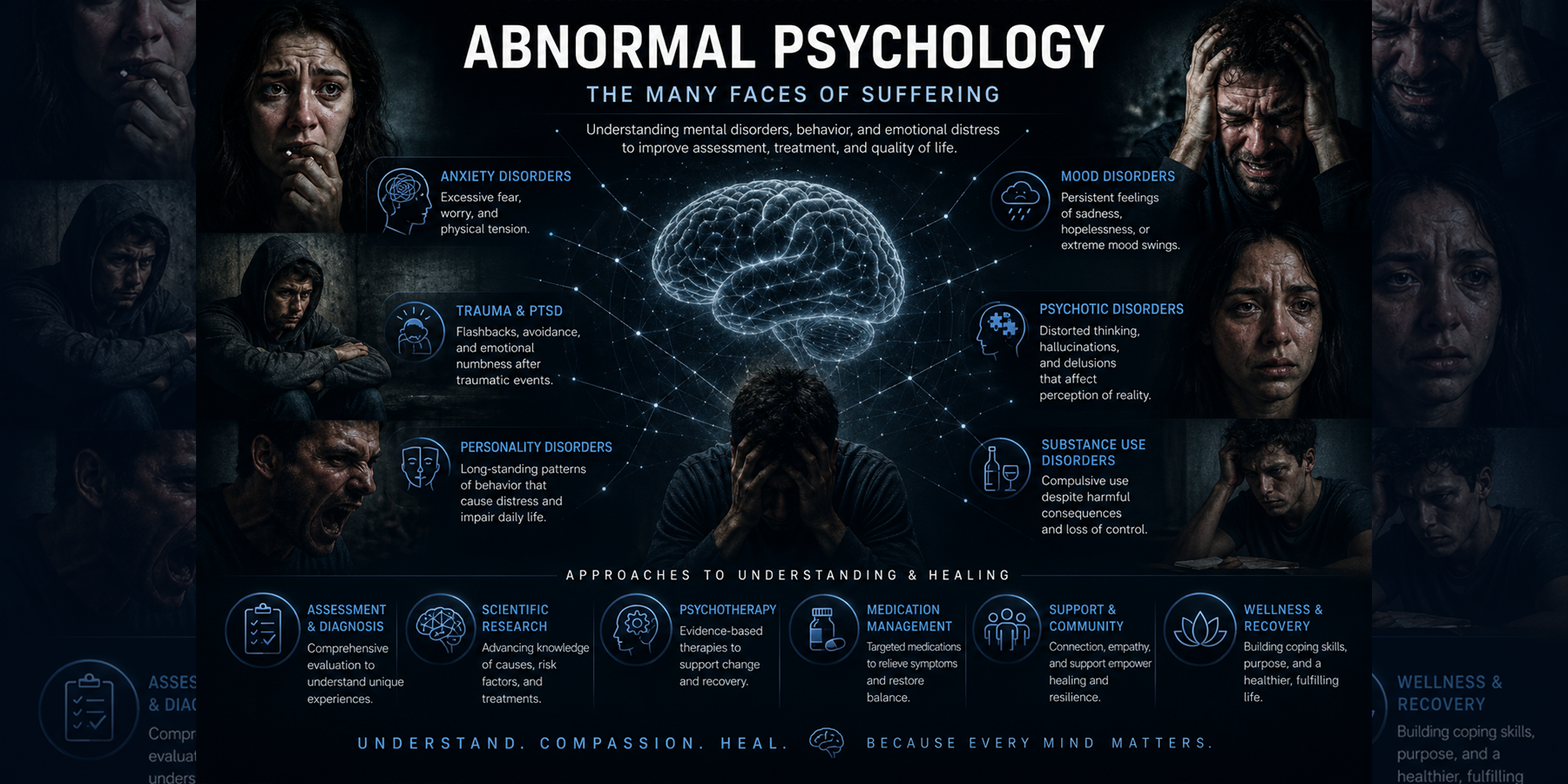
Abstract
Abnormal psychology is the scientific study of psychological disorders, maladaptive behaviors, emotional dysregulation, and atypical cognitive processes that impair functioning and quality of life.
Neuroimaging, genetics, inflammation, connectomics, and molecular neuroscience help explain psychiatric risk and treatment response.
CBT, DBT, exposure therapy, trauma-informed models, and third-wave approaches target thoughts, behaviors, regulation, and resilience.
AI, wearable data, telepsychiatry, mood tracking, and digital phenotyping extend care beyond traditional clinical visits.
Parts I-II
Modern psychiatry uses DSM-5-TR and ICD-11 frameworks, while precision psychiatry adds biomarkers, neuroimaging, genetics, and computational models.
Anxiety disorders involve excessive fear, worry, and avoidance behaviors that significantly impair daily functioning and quality of life.
Generalized anxiety disorder, panic disorder, social anxiety disorder, specific phobias, and agoraphobia.
Mood disorders involve persistent disturbances in emotional state, motivation, energy, cognition, sleep, and function.
Depression, bipolar spectrum conditions, suicide risk, sleep disruption, neurovegetative symptoms, and personalized treatment planning.
Psychotic disorders can affect perception, belief, thought organization, emotional expression, and social functioning.
Assessment may include symptom history, medication response, functional decline, family risk, substance exposure, and neurocognitive testing.
Personality disorders involve persistent patterns in cognition, emotion, interpersonal functioning, and impulse control.
Longitudinal assessment, trauma-informed therapy, DBT skills, relationship patterns, safety planning, and functional goals.
Trauma and chronic stress alter emotional regulation, fear processing, memory systems, stress hormones, and interpersonal safety.
PTSD mechanisms, adverse childhood experiences, avoidance, hyperarousal, intrusive memories, and recovery-focused therapy.
Part III
Modern abnormal psychology integrates brain imaging, genetics, neurotransmitters, inflammation, and molecular neuroscience.
fMRI, PET, and DTI reveal changes in the prefrontal cortex, amygdala, hippocampus, basal ganglia, and anterior cingulate cortex.
Serotonin, dopamine, norepinephrine, glutamate, and GABA pathways contribute to mood, anxiety, psychosis, reward, and cognition.
Twin studies, GWAS, gene-environment interaction, and stress-induced epigenetic changes help explain heritable risk.
Immune dysregulation, cytokine signaling, microbiome shifts, and gut-brain communication are emerging psychiatric research areas.
Part IV
Psychological and behavioral processes remain central to understanding abnormal behavior and developing effective interventions.
Part V
Psychotherapy remains one of the most effective treatments for many psychological disorders.
CBT identifies maladaptive thoughts, restructures cognitive distortions, and modifies problematic behaviors.
DBT emphasizes emotion regulation, distress tolerance, interpersonal effectiveness, and mindfulness skills.
Graduated exposure reduces fear, avoidance, panic, phobias, trauma reactivity, and compulsive safety behaviors.
Mindfulness-based and acceptance-based therapies build psychological flexibility, awareness, and values-directed action.
Part VI
Medication, neuromodulation, and precision tools can be combined with psychotherapy for personalized psychiatric care.
Part VII
Digital platforms, AI, and immersive environments are changing psychiatric evaluation and treatment.
Parts VIII-IX
Progress in mental healthcare must address access, stigma, diagnostic complexity, data privacy, culture, and ethical concerns.
Stigma can reduce help-seeking, delay treatment, and limit access to care across cultures and communities.
Many populations lack adequate psychiatric care, especially in low-resource regions and underserved communities.
AI systems may embed training-data bias, while psychiatric data requires strong privacy and cybersecurity safeguards.
Objective biological markers may improve diagnosis, prognosis, and treatment prediction.
Advanced imaging can map large-scale network dysfunction and guide precision interventions.
Psilocybin and MDMA research is expanding for treatment-resistant conditions under controlled clinical protocols.
References
American Psychiatric Association. (2022). Diagnostic and Statistical Manual of Mental Disorders (5th ed., text rev.).
Bzdok, D., & Meyer-Lindenberg, A. (2018). Machine Learning for Precision Psychiatry. Nature Reviews Neuroscience, 19(10), 639-652.
Insel, T. R. (2022). Digital Phenotyping: Technology for a New Science of Behavior. JAMA, 327(13), 1215-1216.
Meyer-Lindenberg, A., & Tost, H. (2024). Precision Psychiatry: Biomarkers and Personalized Mental Health Care. Molecular Psychiatry, 29, 1540-1556.
National Institute of Mental Health. (2025). Brain Stimulation Therapies.
Topol, E. J. (2019). High-Performance Medicine: The Convergence of Human and Artificial Intelligence. Nature Medicine, 25(1), 44-56.
World Health Organization. (2025). Mental Disorders Fact Sheet.
Wright, J. H., et al. (2017). Learning Cognitive-Behavior Therapy: An Illustrated Guide (2nd ed.). American Psychiatric Publishing.
Yehuda, R., & Lehrner, A. (2018). Intergenerational Transmission of Trauma Effects. World Psychiatry, 17(3), 243-257.
Zhou, T., et al. (2024). Artificial Intelligence and Neuroimaging in Precision Psychiatry. Molecular Psychiatry, 29(2), 422-438.
FAQ
Evidence-based answers to common questions on psychological disorders, neuroscience, therapy, medications, and digital mental healthcare.
Abnormal psychology studies psychological disorders, maladaptive behavior, atypical cognition, emotional dysregulation, and patterns that impair functioning or quality of life.
Depression involves interacting changes in mood circuits, stress biology, sleep, reward processing, cognition, inflammation, neurotransmitters, and social-environmental factors.
CBT, DBT, exposure therapy, trauma-focused therapies, mindfulness-based approaches, and family or interpersonal therapies all have evidence for specific conditions.
Major classes include antidepressants, antipsychotics, mood stabilizers, anxiolytics, stimulants, and medications targeting sleep, addiction, or specific symptom clusters.
Digital tools support telepsychiatry, mood tracking, wearable monitoring, AI risk prediction, digital phenotyping, cognitive training, remote therapy, and crisis support.